Never overwrite the original
The single most damaging habit, and the easiest one to avoid.
Volume 05, Chapter 5
A version number lets the business reproduce exactly what any past customer received. Deleting v1 the moment v2 exists makes that impossible.
Every structural change becomes a new, numbered version, with old versions kept, not deleted. This protects every order ever made under an earlier version.
The single most damaging habit, and the easiest one to avoid.
Did the shape change for everyone, or just fit one body? That's the whole distinction.
A version record without a reason is half a record.
Software releases, artwork revisions, recipe ratios, all version the same way.
Imagine a bride's daughter asks for a wedding dress made "exactly like Mum's, ten years ago." In the years since, the original pattern has been redesigned twice for other customers. If each redesign had simply overwritten the file before it, that request would be impossible, nobody could say exactly what the original looked like anymore. A pattern's history is only useful if the old versions are still there to look at.
is the discipline of keeping every past state of a pattern retrievable when it changes, never overwriting or destroying the previous version, only adding a new one alongside it.
What if the sleeve changes? Don't destroy the old pattern. Version it. Every structural change to an existing pattern becomes a new, numbered version, v1, v2, v3, with the old versions kept, not deleted. This protects every order ever made under an earlier version, and lets the business answer, with certainty, "exactly what did we make for this customer, and when?"
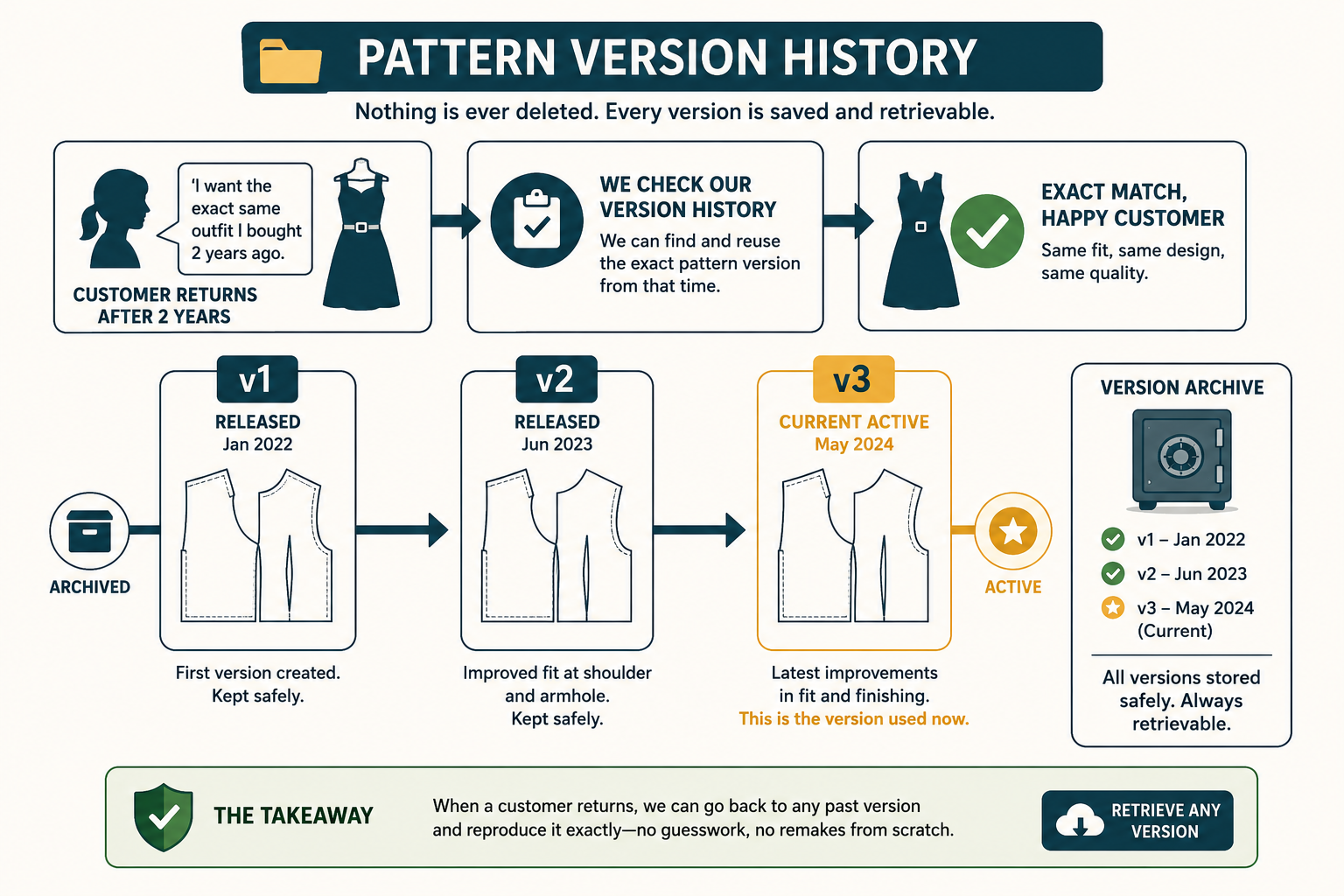
If a customer returns wanting an identical repeat of a garment ordered two years ago, but the pattern has since changed twice, only the original version reproduces exactly what they received. Overwriting it would silently make that promise impossible to keep, and nobody would even notice until the customer arrived expecting the old fit.
Keeping a version means the business can still reproduce exactly what a past customer received. Deleting v1 the moment v2 exists makes that impossible, even for orders already delivered under v1.
This distinguishes cleanly from Chapter 3's grading and alterations:
The pattern's shape or construction itself changed, for everyone who might use it.
StructuralOnly one customer's body measurements changed, same version underneath.
Individual fit| Change | New Version, or Just an Alteration? |
|---|---|
| Sleeve style changed from fitted to flared | New version, the pattern itself changed structurally |
| Same sleeve style, resized for a bigger arm | Alteration/grading, same version, different body |
| Collar redesigned entirely | New version |
| Fabric changed, pattern shape unchanged | Not a new version, the pattern itself didn't change |
The test: did the actual shape or construction of the pattern change, for everyone who might use it? If yes, it's a new version. If only one customer's measurements changed, it's an alteration.
| Field | Example |
|---|---|
| Pattern code | DR-2026-041 |
| Version number | v3 |
| Date | 2026-03-14 |
| What changed | Adjusted collar shape, narrower by 1cm |
| Changed by | Head Cutter |
| Reason | Customer feedback on v2's collar fit |
| Status of previous version | Archived, not deleted |
This is the version history section of the Pattern Register Template from Chapter 4.
A customer's daughter wanted her wedding dress made "exactly like Mum's, ten years ago." Because MANIAC MINDZ had never deleted the original v1 pattern, even though it had been revised twice since for other customers, the Head Cutter pulled the exact decade-old version and reproduced it precisely, down to the original sleeve shape nobody currently made anymore.
Had v1 been overwritten by v2 or v3, that request would have been impossible to fulfill accurately, the business would have been forced to guess, or disappoint a customer with real sentimental stakes in getting it exactly right.
| Business | Version Control in Practice |
|---|---|
| Nimbus Labs | Every software release is a numbered version, with old versions never deleted, enabling instant rollback if a new version breaks something |
| Precision Print & Press | A client's logo artwork keeps every revision on file, so an old print run can be exactly reproduced |
| Golden Crust Bakery | A recipe's ingredient ratios are versioned when genuinely changed, distinct from simply doubling a batch size |
The single most damaging habit in this chapter, see the wedding dress story. Always save as a new version; never edit and resave over the original.
Creating a "new version" for every individual customer's body measurements clutters the pattern library with near-duplicates that aren't actually reusable designs, see Section 3.