Blend the three methods
Most healthy small businesses don't pick just one pricing method.
Volume 07, Chapter 6
Every sale must first cover its share of fixed costs before it adds to profit. Sales below the break-even point are still paying off fixed costs; only sales above it are genuinely profit.
Cost-plus, competitive, and value-based pricing are three honest starting points. Most healthy small businesses blend all three, but none of them replace the break-even check.
Most healthy small businesses don't pick just one pricing method.
A margin that beats cost alone can still lose money once expenses are included.
A lower price raises the volume needed just to break even.
A competitor's price may reflect a completely different set of costs.
Imagine a well-meaning sales push offers a 20% discount to boost slow-season volume. It feels harmless, a modest cut to bring in more customers. Nobody recalculates what that discount does to the numbers underneath it, and it turns out the business would now need to sell almost double its usual volume just to break even. A price that looks generous can quietly turn every sale into a loss.
A pricing policy is a documented, repeatable method for setting prices, so that "what should we charge?" has a consistent answer, instead of being decided fresh, by feel, for every single order.
There are three honest starting points for a price: what it costs you to make (cost-plus), what similar options charge (competitive), and what it's genuinely worth to the customer (value-based). Most healthy small businesses blend all three, but every price should be checked against one hard floor: the break-even point, the exact number of sales below which the business loses money no matter how busy it looks.
Price = total cost per unit + a target margin. Simple, defensible, hard to underprice by accident.
Price = what similar businesses charge, adjusted for how your business compares. Best for visible, comparable markets.
Price = what the specific benefit is worth to this customer. Best for bespoke or brand-driven work.
| Method | How It Works | Best For |
|---|---|---|
| Cost-plus | Price = total cost per unit + a target margin | Simple, defensible, hard to underprice by accident |
| Competitive | Price = what similar businesses charge, adjusted for how your business compares | Markets with visible, comparable alternatives |
| Value-based | Price = what the specific benefit is worth to this customer | Bespoke, differentiated, or brand-driven work (Volume 01's competitive advantage) |
Worked example, cost-plus, MANIAC MINDZ:
| Amount | |
|---|---|
| Fabric, thread, trims (cost) | ₦8,000 |
| Direct labour (cost) | ₦4,000 |
| Total cost per garment | ₦12,000 |
| Target margin (50%) | +₦6,000 |
| Price | ₦18,000 |
Cost-plus pricing that only counts cost (per Chapter 5's definition) and ignores a fair share of expenses (rent, admin) will look profitable per garment and still lose money overall once expenses are included. The margin must be big enough to cover expenses too, not just costs, that's exactly what break-even checks.
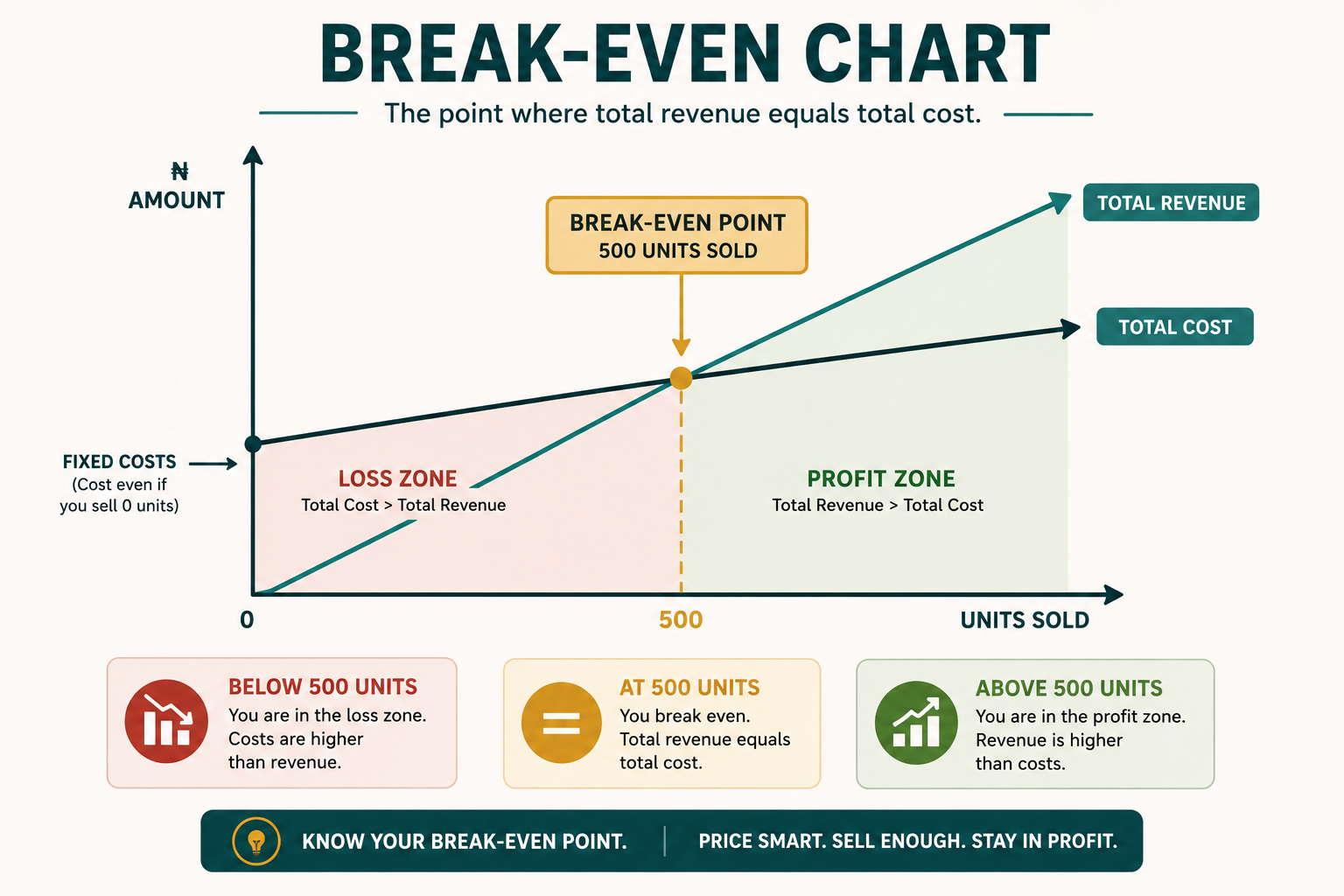
Break-even is the number of units that must be sold, at a given price, for total revenue to exactly equal total costs, the point where profit turns from negative to positive.
Break-even units = Fixed Costs ÷ (Price per unit − Variable cost per unit)
Worked example:
| Amount | |
|---|---|
| Fixed costs (rent, admin salaries, etc.) | ₦2,000,000/month |
| Price per garment | ₦12,000 |
| Variable cost per garment | ₦8,000 |
| Contribution per garment (Price − Variable Cost) | ₦4,000 |
| Break-even units | ₦2,000,000 ÷ ₦4,000 = 500 garments/month |
Below 500 garments a month, the business loses money even though every single sale looks individually profitable. Above 500, every additional garment adds pure profit, since fixed costs are already covered. Full worked template: Break-Even Calculator.
Every sale must first cover its share of fixed costs before it adds to profit. Sales below the break-even point are still paying off fixed costs; only sales above it are genuinely profit.
Here's the full version of the discount story from the start of this chapter.
A well-meaning sales push at MANIAC MINDZ offered a 20% discount to boost slow-season volume. Nobody had recalculated break-even at the new, lower price, and the new contribution per garment fell so far that the business would have needed nearly 900 garments a month just to break even, almost double the usual volume. The discount was quietly capped and re-costed before it ran a full month, once the math was actually checked.
| Business | Primary Pricing Method | Why |
|---|---|---|
| MANIAC MINDZ | Cost-plus, blended with value-based for bespoke work | Predictable costs, but unique designs justify a premium |
| Golden Crust Bakery | Competitive | Bread is a visible, easily compared product |
| Nimbus Labs | Value-based | The software's benefit to the customer, not its cost to build, drives what they'll pay |
A margin that only beats direct cost, without covering a fair share of fixed expenses, can look profitable per unit and still lose money overall. Always check against break-even.
As in the example story, a discount changes the contribution per unit, which changes how many units are needed just to survive.
A competitor's price may reflect a completely different set of costs. Competitive pricing should inform, not replace, your own cost-plus and break-even math.