Not an insult to trusted staff
Controls protect honest employees at least as much as the business.
Volume 11, Chapter 1
Controls don't assume dishonesty, they remove temptation. Trust alone is not a control.
Fraud requires all three legs of the triangle at once. Remove one, and fraud becomes far less likely.
Controls protect honest employees at least as much as the business.
The cheapest time for a control is before it's ever tested.
Even a two-person business has one relationship to check.
The one rule every chapter in this volume applies differently.
Imagine a business introduces a rule that no single payment above a set amount can go out without a second person's sign-off. The employee whose sole authority just got reduced feels, at first, mildly distrusted. Months later, that same rule catches a fraudulent payment request before it can be sent. The employee wasn't the one being protected from suspicion, she was the one the rule protected from ever being wrongly suspected, because the record now shows two people reviewed it, not one person acting alone.
are the rules that decide who can count cash, approve an expense, sign a payment, or access a company account, designed so that no single person ever has complete, unchecked power over money or goods, however trusted they are.
Internal controls aren't built because employees are assumed dishonest, they're built because trust alone is not a control. This volume is the specific mechanism behind Chapter 3's fraud "risk of presence" and the "Loose Cannon" quadrant from Volume 06, Chapter 1. Unchecked authority, held long enough, eventually costs a business money, regardless of how honest any individual person is.
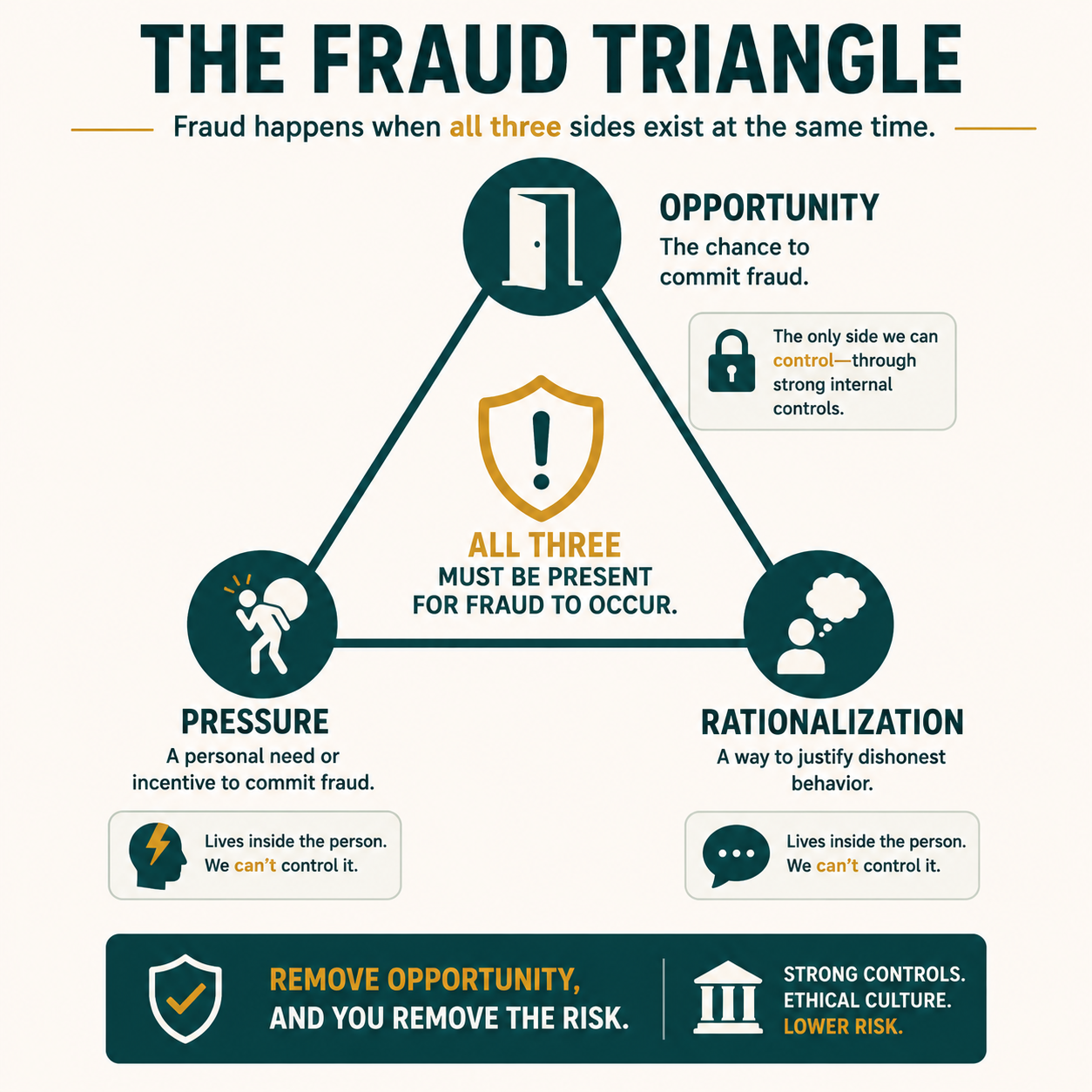
A well-established idea in risk management: fraud requires three things at once. Remove any one, and fraud becomes far less likely.
Unchecked access, no second reviewer, no checking against records. Yes, this is what internal controls remove.
Personal financial strain pushing someone toward temptation. No, this lives in someone's private life.
The internal story that makes it feel acceptable. Only indirectly, through fair pay and culture.
Vol 28| Leg | What It Means | Can the Business Control It? |
|---|---|---|
| Opportunity | Unchecked access, no second reviewer, no checking against records | Yes, this is what internal controls remove |
| Pressure | Personal financial strain pushing someone toward temptation | No, this lives in someone's private life |
| Rationalization | The internal story that makes it feel acceptable ("I'm underpaid," "I'll pay it back") | Only indirectly, through fair pay and culture (Volume 28) |
This chapter's whole argument in one line: a business cannot control pressure or rationalization, but it can remove opportunity entirely, and that's exactly what every chapter in this volume does.
Controls don't assume dishonesty, they remove temptation. The most protective thing a business can do for an honest employee is make sure they're never placed in a position where a bad month and one moment of weakness could cost them everything.
Every chapter in this volume is one application of the same rule:
| Chapter | The Rule, Applied |
|---|---|
| Chapter 2: Segregation of Duties | No one person handles an entire transaction alone |
| Chapter 3: Cash Controls | No one person counts, banks, and reconciles cash alone |
| Chapter 4: Approval Authority | No one person approves unlimited spending alone |
| Chapter 5: Access Controls | No one person holds every password and access credential alone |
Here's the full version of the second-signature story from the start of this chapter.
When MANIAC MINDZ introduced a second-signature rule for payments above a set amount (Volume 10, Chapter 5's phishing story), the staff member whose sole authority was reduced initially felt mildly distrusted. Months later, that same rule caught a fraudulent payment request before it could be sent, protecting not just the business's money, but that same employee from ever being wrongly suspected, since the record now clearly showed two people reviewed every large payment, not one person acting alone.
| Business | An "Opportunity" Worth Closing |
|---|---|
| City Kitchen | One person both taking cash and recording the till total |
| Rapid Auto Works | One person both ordering parts and approving the supplier invoice |
| Nimbus Labs | One developer holding sole access to the live customer database |
As the example story shows, controls protect honest employees at least as much as they protect the business.
The cheapest time to build a control is before it's ever tested, see Volume 10's whole risk-response philosophy.
A two-person business still has exactly one relationship where "no single point of control" can be tested. Controls scale down, they don't disappear.
List every point in your business where one person currently holds complete, unchecked control over money, goods, or access. For each, note which chapter of this volume (2–5) closes that specific gap.