Volume 13, Chapter 1
Raw Materials, Work-in-Progress, and Finished Goods
Definition
Imagine a rushed, urgent reorder of a specific fabric turns out to be completely unnecessary. Three full rolls were already sitting in a back corner of the storeroom the whole time, bought for an order that later changed specification, never counted, never logged anywhere. The money had already been spent months earlier. It just wasn't being tracked as inventory, so nobody realized it was there to use.
is everything a business owns that will eventually be sold or used up in making what it sells, at any stage between arriving and leaving. It moves through three distinct stages, raw materials, work-in-progress (WIP), and finished goods, and each stage needs to be tracked differently.
This is Volume 01's business loop made concrete: materials go in (raw materials), processes happen (work-in-progress), products come out (finished goods). Confusing the three stages, or worse, not tracking one of them at all, is how a business loses track of exactly how much money is sitting on its shelves and workbenches at any given moment.
The Three Stages
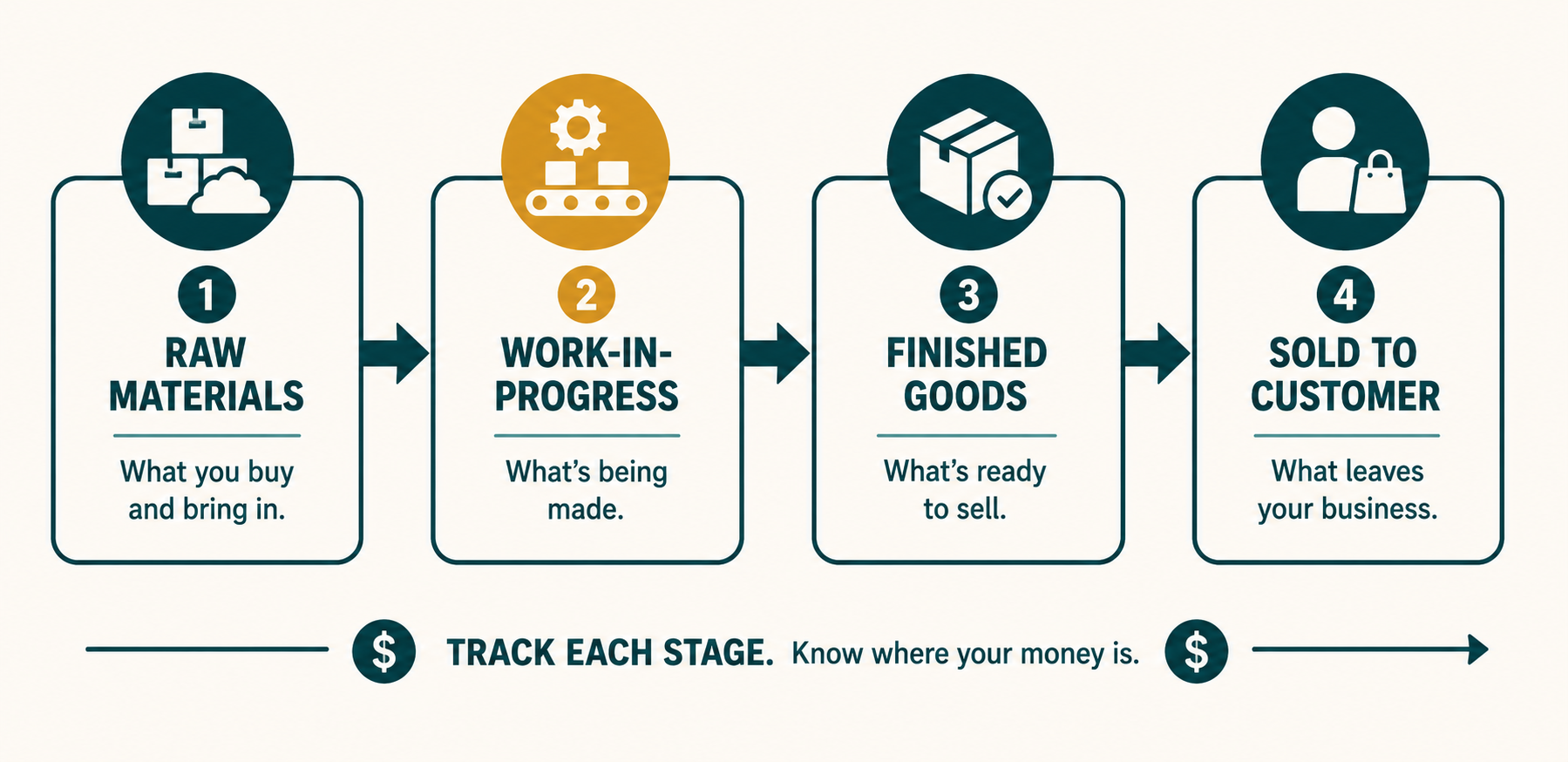
| Stage | What It Is | MANIAC MINDZ Example |
|---|---|---|
| Raw materials | Inputs bought but not yet used | Fabric rolls, thread, buttons, zips, still in storage |
| Work-in-progress (WIP) | Partially completed items | A garment that's been cut but not yet sewn |
| Finished goods | Complete, ready to deliver | A finished garment awaiting customer collection |
Each stage represents real money the business has spent but not yet recovered, precisely Volume 07, Chapter 1's capital-vs-profit warning: fabric sitting as raw material, a half-sewn garment sitting as WIP, and a finished garment awaiting collection are all still capital, not yet profit, however far along the process they've come.
Raw materials, WIP, and finished goods are three different stages of the same inventory, not three separate things. None of the three is money in the bank yet.
Why Tracking All Three Separately Matters
| If Only Finished Goods Are Tracked... | What's Missed |
|---|---|
| Raw material levels are unknown | Risk of running out mid-order, or over-ordering unnecessarily |
| WIP is invisible | No way to know how much value is currently "stuck" in production |
| True capital tied up is understated | Decisions about cash and reordering are made on incomplete information |
A business that only counts finished garments on the shelf has no idea how much fabric is sitting unused, or how many partially-sewn garments represent money and labour already spent but not yet recoverable.
Example Story: The Fabric Nobody Knew They Had
Here's the full version of the untracked-fabric story from the start of this chapter.
A rushed reorder of a specific fabric type turned out to be unnecessary. Three full rolls were already sitting, uncounted and unlogged, in a back corner of the MANIAC MINDZ storeroom, purchased for an order that had since changed specification. The money had already been spent. It just wasn't being tracked as raw material inventory, so nobody realized it was available. The fix was simple: every raw material delivery (Volume 12, Chapter 3's receiving process) now gets logged into a running inventory record the same day, not just filed away physically.
Across Industries
| Business | Raw Material | WIP | Finished Goods |
|---|---|---|---|
| Golden Crust Bakery | Flour, yeast, sugar | Dough proving, bread in the oven | Cooled, packaged bread |
| Rapid Auto Works | Spare parts in stock | A vehicle mid-repair | A repaired, ready-for-collection vehicle |
| Precision Print & Press | Blank paper stock, ink | A job mid-print run | Finished, bound print jobs |
Common Mistakes
Hides how much capital is tied up in raw materials and WIP, see the fabric story.
A half-finished garment still represents real spent money and labour, it needs to be counted, not ignored until complete.
Delayed logging is exactly how inventory becomes invisible, even briefly, per Volume 12, Chapter 3's receiving discipline.
Quiz Yourself
Practice Exercise
Walk your production space today. Count and log everything at each of the three stages, raw materials, WIP, finished goods, even if it's never been tracked this way before.
Quick Summary
Quick Summary
- Inventory moves through three stages: raw materials, work-in-progress, finished goods, each representing real, unrecovered capital.
- Tracking only finished goods hides how much money is tied up in materials and production.
- Log raw materials into inventory records the same day they're received.