Volume 15, Chapter 1
Customer Registration and History
Definition
Imagine a first-time customer walks in on a hectic day. The sale happens fast. Nobody writes down her name, her measurements, or the fabric she liked. Three months later she returns, expecting the shop to remember her. Nobody does. She has to explain everything again, as if she had never been there at all.
is the moment a new customer's details are first captured in writing. Customer history is everything that accumulates afterward, every order, preference, and interaction, so that no customer ever has to "start over" on a return visit.
Why does it matter whether details get written down at the very first visit, rather than the second or third? Because a customer's history is only ever as complete as its starting point. A regular who has to keep re-explaining themselves every visit never actually feels like a regular.
Volume 04, Chapter 7 already defined what fields belong on a customer record. This chapter is the process side: exactly when registration happens, what consent is needed, and how history is expected to grow with every single visit, never left to whoever happens to remember the regular customer.
The Customer Lifecycle
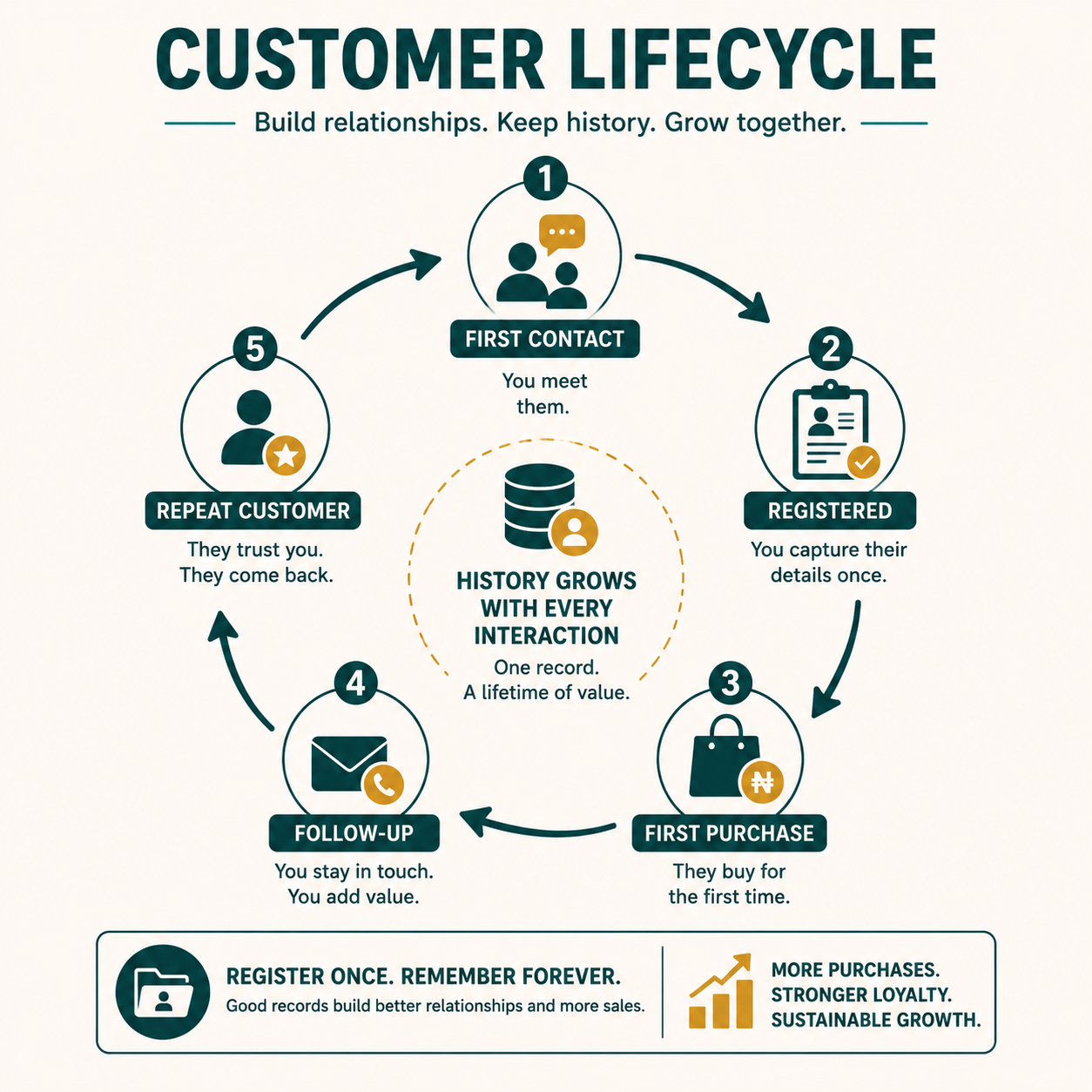
Registration happens once, at first contact or first purchase, everything after that is history accumulating on top of it.
| Stage | What Happens |
|---|---|
| 1. First Contact | An inquiry, a walk-in, a referral, before any record exists yet |
| 2. Registered | Core details captured: Customer Registration Form |
| 3. First Purchase | The first order becomes the first entry in that customer's history |
| 4. Follow-Up | Confirmed delivery, a satisfaction check-in, Chapter 4 |
| 5. Repeat / VIP | Enough history accumulates to consider loyalty status |
Registration is a single moment. History is everything that happens after it, forever. A business that only does the first and skips the second still treats every regular like a stranger.
Consent and Data Protection
Registering a customer means collecting personal information, which immediately brings in Volume 09, Chapter 6's data protection principles: collect only what's actually needed, explain what it will be used for, and don't reuse it (e.g., a phone number collected for order updates) for unrelated marketing without asking first.
A registration process that collects more personal information than the business actually uses isn't "being thorough", it's unnecessary risk under Volume 09's data protection obligations.
Example Story: The Registration That Almost Didn't Happen
Here's the full version of the forgotten-customer story from the start of this chapter.
A first-time customer at MANIAC MINDZ almost left without any record being created at all: a busy day, a quick sale, no time taken to note her details. The fix was one small habit change: the registration form now gets filled in before the sale is finalized, not left as an afterthought for whenever things quiet down.
Three months later, that same customer returned. Her measurements and fabric preference were already on file. The second sale took a fraction of the time the first one had.
Across Industries
What gets captured at registration depends entirely on what the business needs to remember to serve that customer well next time.
| Business | What Gets Captured at Registration |
|---|---|
| Golden Crust Bakery | Standing weekly orders, allergy/dietary notes |
| Rapid Auto Works | Vehicle make/model/plate, service history |
| Precision Print & Press | Brand colours, logo files, preferred paper stock |
Common Mistakes
The exact failure in the example story, the moment it's skipped "just this once" is the moment history stops accumulating for that customer.
Violates Volume 09's "collect only what's needed" principle.
The exact failure Volume 04, Chapter 7 already warned against, it leaves the business the day that employee does.
Quiz Yourself
Practice Exercise
Review your last five new customers. Does each have a written record from their very first visit, or did some only get recorded after a second or third purchase? Close that gap going forward.
Quick Summary
Quick Summary
- Registration happens once, at first contact; history accumulates on top of it with every visit afterward.
- Registering a customer means collecting personal data, data protection principles apply from the very first form.
- History that lives only in an employee's memory disappears the day that employee does.