Volume 18, Chapter 1
Opening and Closing Checklists
Definition
One night at MANIAC MINDZ, the shop was busy right up to closing time. Everyone was tired and wanted to go home. One person said, "Let's skip counting the cash tonight. We'll do it in the morning." Everyone agreed. It saved five minutes. The next morning, the cash drawer was short. Now nobody could tell what had happened. Was the money already missing the night before? Or did it go missing that morning? Nobody knew. The missing money was not the real problem. The real problem was this: the business had skipped the one step that would have shown them when the money disappeared.
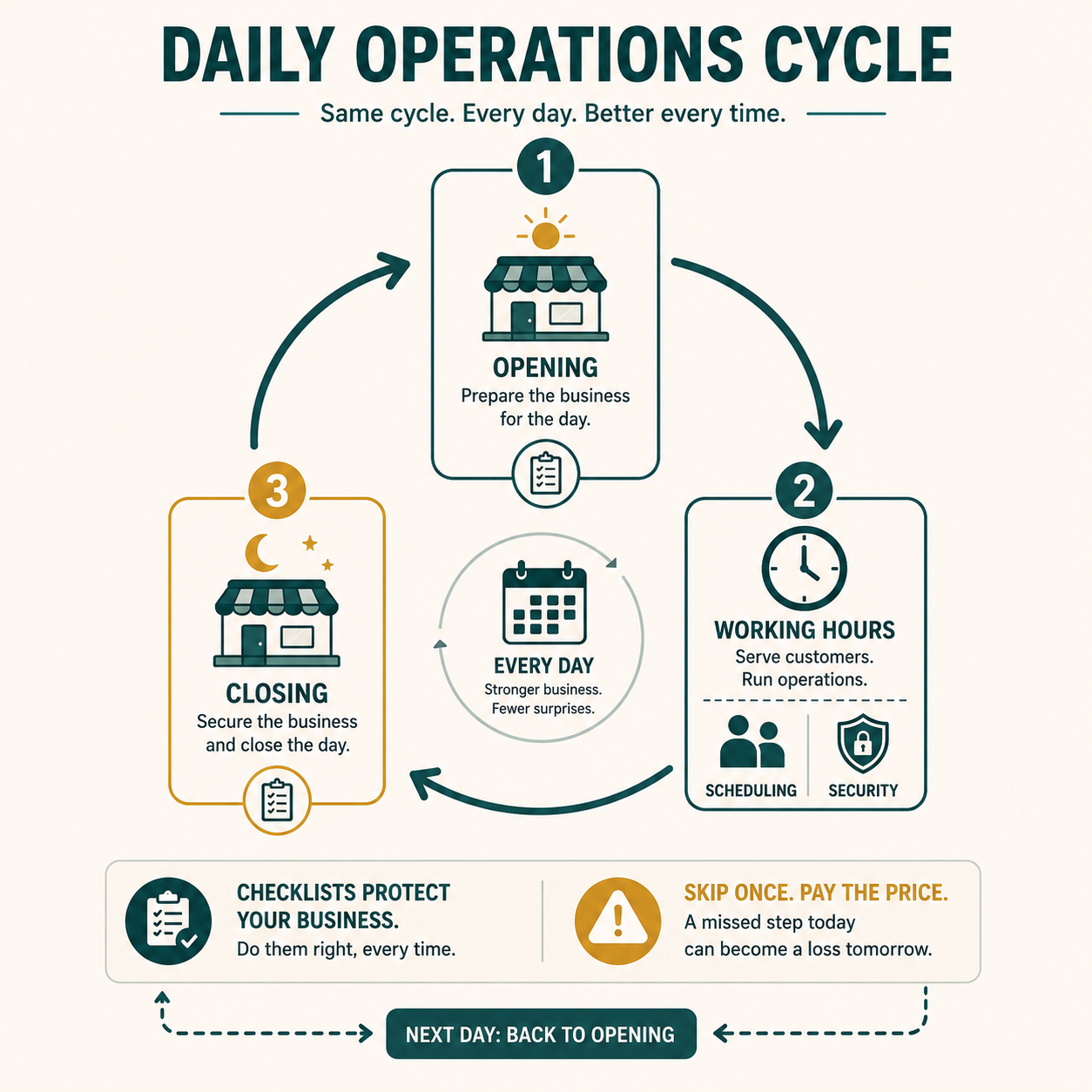
An opening checklist is the fixed sequence of tasks performed at the start of every business day; a closing checklist is its mirror at the end. Both exist so the business starts and ends each day the same way, regardless of who's working or how rushed it feels.
Why does one skipped step on one busy night matter enough for a whole chapter? Because "skip it just this once" never stays a one-time thing. Once a step is allowed to be skipped when people are busy, it gets skipped again. And busy nights are exactly when things go wrong: cash goes missing, a door is left unlocked, a machine is left running. So the step gets dropped at the worst possible moment. A checklist takes the choice away. If a task is on the list, it gets done, busy or not.
Opening and closing are exactly the kind of recurring task Volume 02 says should never depend on memory. Done correctly a thousand times, they're invisible. Skipped once, they can cause a real loss the very next day.
The Daily Cycle
| Opening | Closing | |
|---|---|---|
| Security | Disarm alarm, unlock, confirm no overnight damage | Lock every entry point, arm alarm |
| Cash | Count and record the starting cash (Volume 11's cash controls) | Count and check it against the day's sales |
| Equipment | Power on, quick visual check (Chapter 2) | Power off, quick condition check |
| Space | Confirm ready for customers/production | Basic tidy and security walk-through |
If it wasn't checked off, assume it wasn't done, no matter how routine it feels. The riskiest step is always the one everyone assumes someone else already handled.
Why It Needs to Be Written, Not Remembered
Whoever opens or closes on a given day shouldn't need to be the most experienced person on staff. A written checklist means the sequence is correct regardless of who's holding it. That is exactly Volume 02's core argument about systems beating memory.
Example Story: The Step That Got Skipped on a Busy Night
Here's the full version of the skipped-cash-count story from the start of this chapter.
That night, the shop stayed busy right up to closing time. Everyone was tired. Counting the cash felt like something that could wait until morning, so they left it. By morning, the drawer was short. Nobody could tell whether the money went missing that night or the next day.
One simple rule fixed it for good. The closing checklist must be signed before anyone leaves, no matter how busy the night was. If a signature is missing, everyone sees it straight away. "We'll get to it in the morning" is no longer an option.
Across Industries
The core opening and closing steps stay the same everywhere; what changes is which specific check matters most for each trade.
| Business | An Opening/Closing Step Specific to Them |
|---|---|
| Golden Crust Bakery | Oven preheat check at opening; ingredient storage temperature check at closing |
| Rapid Auto Works | Tool inventory check at opening; vehicle lot security check at closing |
| Precision Print & Press | Machine settings check at opening; paper stock lockup at closing |
Common Mistakes
Falls apart the moment someone unfamiliar with the routine is the one opening or closing.
This is the exact failure in the example story. Busy moments are precisely when a written checklist matters most.
Without a signature or check-mark, there's no way to prove the checklist was actually done, not just assumed.
Quiz Yourself
Practice Exercise
Write your own opening and closing checklists using the Daily Opening Checklist and Daily Closing Checklist as a starting template, adjusted for your specific business.
Quick Summary
Quick Summary
- Opening and closing checklists make sure the day starts and ends the same way, regardless of who's on shift.
- Written checklists beat memory, especially on busy days when steps are most likely to be skipped.
- Require a sign-off so completion is visible, not assumed.