Volume 22, Chapter 1
The Meeting Rhythm: Daily, Weekly, Monthly, Annual
Definition
MANIAC MINDZ once ran a single weekly "everything meeting" that tried to do it all: daily task assignment, monthly numbers, and the occasional drift into strategy, all mixed into one recurring slot. It ran long and satisfied nobody. Strategic questions kept getting deferred because the room was full of people who didn't need to be there for that part.
is a set of recurring meetings at different levels, each with its own purpose, question, and guest list. Volume 21, Chapter 3 already defined what gets reviewed at each time horizon, this chapter is the actual meeting format where that review happens.
Why does bundling every purpose into one meeting hurt all of them, instead of just being efficient? Because daily urgency and long-term strategy compete for the exact same attention, and whichever one is loudest in the room wins, every time, at the expense of the other. Separating them by level isn't pointless extra process, it's what lets each conversation actually happen.
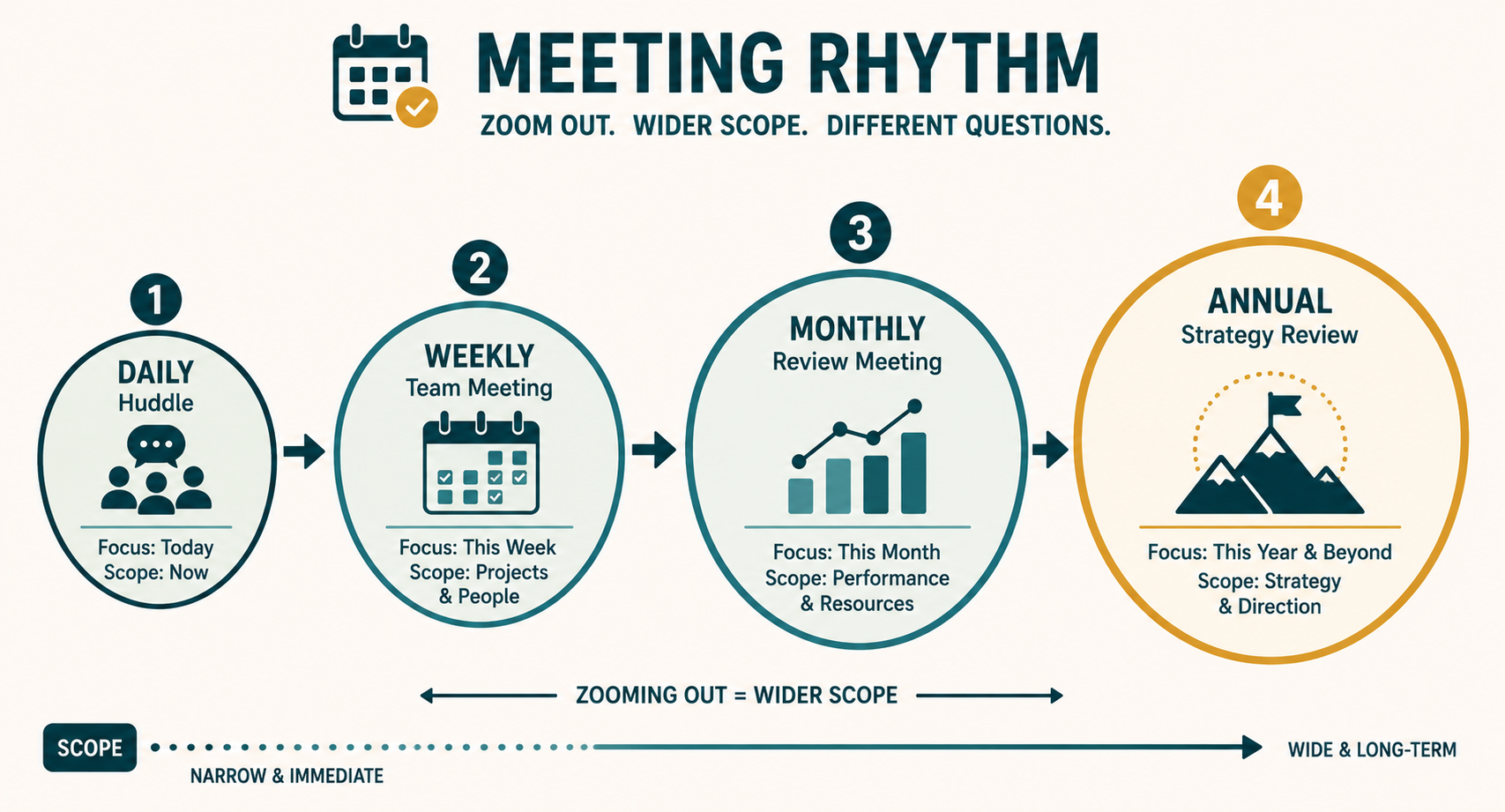
Four meetings, four different jobs: a daily briefing coordinates today; a weekly meeting coordinates the team's work; a monthly meeting reviews the dashboard; an annual meeting reviews the whole strategy. Mixing them into one all-purpose meeting serves none of these purposes well.
The Four Levels
| Meeting | Question | Typical Attendees |
|---|---|---|
| Daily | What's the priority today? (per Volume 18's workflow scheduling) | Whoever's working that day |
| Weekly | Is the team's work coordinated and on track? | Team leads |
| Monthly | Are the dashboard's KPIs and budget on track? | Owner, managers |
| Annual | Does the whole strategy still make sense? | Owner, leadership |
Each level zooms out to a wider scope, with a different question and a different guest list. A daily briefing that drifts into annual strategy wastes the whole team's time on a conversation that is meant for four people, once a year.
Why Mixing Levels Fails
A single meeting trying to cover today's priorities, this month's numbers, and next year's strategy all at once tends to do all three poorly: daily urgency crowds out strategic thinking, and strategic detours crowd out the clear plan for the day's work everyone actually needed that morning.
Example Story: The Meeting That Tried to Do Everything
Here's the full version of the everything-meeting story from the start of this chapter.
MANIAC MINDZ once ran a single weekly "everything meeting" that tried to do it all: daily task assignment, monthly numbers, and the occasional drift into strategy, all mixed into one recurring slot. It ran long and satisfied nobody. Strategic questions kept getting deferred because the room was full of people who didn't need to be there for that part.
Nobody in that meeting was doing anything wrong. The meeting itself was just trying to be four meetings at once. Splitting it into a short daily briefing, a focused weekly team meeting, and a separate monthly numbers review meant each meeting became short, relevant, and actually useful to everyone in the room.
Across Industries
The specific meeting that matters most shifts by trade, but the underlying discipline, one level, one purpose, stays the same.
| Business | A Meeting Specific to Them |
|---|---|
| Golden Crust Bakery | Daily briefing on the day's standing orders and any special requests |
| Rapid Auto Works | Weekly bay-scheduling coordination meeting |
| Precision Print & Press | Monthly equipment-capacity and job-backlog review |
Common Mistakes
The exact failure in the example story, poorly serves every purpose at once.
Frontline staff sitting through annual strategy, or leadership micromanaging daily task assignment, wastes time on both ends.
An unscheduled meeting is easy to skip precisely when it's most needed.
Quiz Yourself
Practice Exercise
Review your current meetings. Does each have one clear cadence-appropriate purpose and the right attendees, or is one meeting quietly trying to do the job of several?
Quick Summary
Quick Summary
- Four meeting levels, daily, weekly, monthly, annual, each with its own question and attendees.
- Mixing levels into one meeting tends to serve every purpose poorly.
- A fixed schedule matters, an unscheduled meeting is easy to skip.