Volume 23, Chapter 1
Documenting What People Know
Definition
One long-serving tailor at MANIAC MINDZ held a specific, subtle quality judgment: knowing exactly when a certain fabric was "ready" for a particular technique. It existed only in that tailor's experience, never written down because it had never needed to be. When that tailor was unexpectedly unavailable for several weeks, orders requiring that judgment stalled completely.
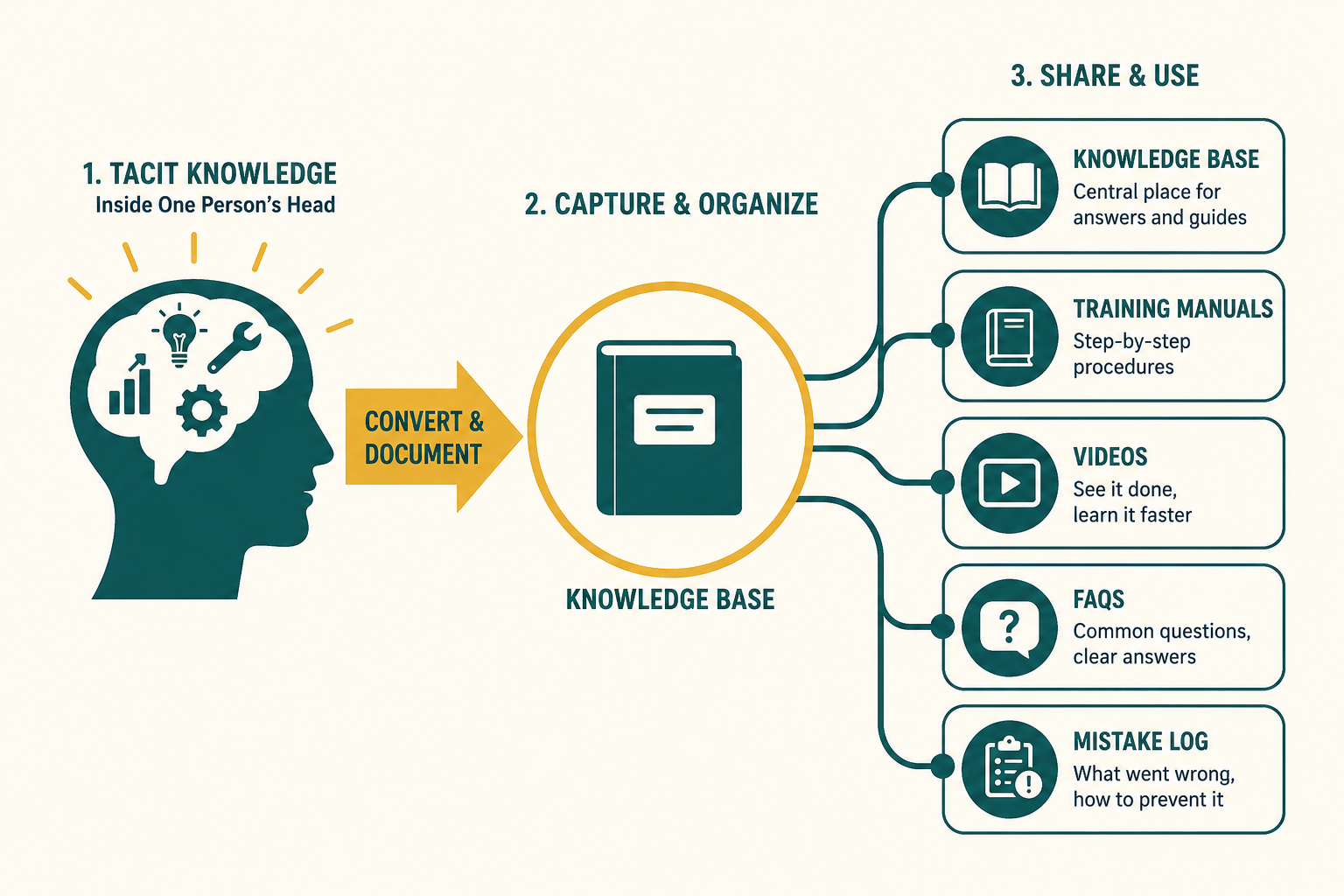
is what an experienced person knows but has never written down, a knack, a workaround, a judgment call made "by feel." Documenting it turns invisible expertise into a Knowledge Base anyone can consult, before it walks out the door with the person who holds it.
Why did nobody else feel confident making that same call? Because the tailor's judgment had never been broken down into anything another person could learn, it lived entirely as a feeling, not a set of signs someone could check for themselves. Knowledge that only exists in one person's experience is knowledge the business doesn't actually have, it's just borrowing it, one day at a time.
This is Volume 02's whole argument at its most urgent: the moment a skilled employee resigns, retires, or becomes unavailable, everything they knew but never documented is gone with them. This chapter is about catching that knowledge on paper (or video) while it's still available to capture.
Signs Knowledge Is Dangerously Tacit
| Warning Sign | What It Means |
|---|---|
| "Ask [specific person]" is the standard answer | Nobody else can currently answer that question |
| A task only one person has ever performed | No documented process exists to fall back on |
| A judgment call made "by feel" | The reasoning behind it has never been put into words |
| A workaround for a known problem, never written down | The fix disappears the day the person who found it leaves |
If the answer to "how do we do this?" is a person's name instead of a document, that knowledge is one resignation away from disappearing.
Capturing It
A Knowledge Base entry doesn't need to be polished, it needs to exist. Interview the person who knows the task, write down the steps and the why behind each judgment call, and have someone unfamiliar with the task try to follow it, exactly like Volume 02's Two-Week Test.
Example Story: The Judgment Call Nobody Else Could Make
Here's the full version of the fabric-ready story from the start of this chapter.
One long-serving tailor at MANIAC MINDZ held a specific, subtle quality judgment: knowing exactly when a certain fabric was "ready" for a particular technique. It existed only in that tailor's experience, never written down because it had never needed to be. When that tailor was unexpectedly unavailable for several weeks, orders requiring that judgment stalled completely, with nobody else confident enough to make the call.
The tailor hadn't been hiding anything. The knowledge had simply never left their head. A single afternoon spent documenting the specific, concrete signs that tailor actually looked for, turning "I just know" into a written checklist, meant the next unexpected absence caused no disruption at all.
Across Industries
Every trade has its own version of a judgment call that lives in one person's experience and nowhere else.
| Business | Tacit Knowledge Worth Documenting |
|---|---|
| Golden Crust Bakery | Knowing dough is "ready" by feel and smell, not just a timer |
| Rapid Auto Works | Diagnosing an unusual engine sound before running the formal tests |
| Precision Print & Press | Judging when a colour proof "looks right" beyond the numeric values |
Common Mistakes
The exact risk in the example story, until it suddenly isn't.
By then, the person with the knowledge may already be gone, or too rushed to properly explain it.
"Do X" without "because Y" leaves a follower unable to adapt when circumstances differ slightly.
Quiz Yourself
Practice Exercise
Identify one task in your business that only one person currently knows how to do well. Interview them using the Knowledge Base Entry Template this week.
Quick Summary
Quick Summary
- Tacit knowledge, a knack, a workaround, a judgment call, disappears the moment its holder becomes unavailable.
- The clearest warning sign: "ask [specific person]" as the standard answer to a real business question.
- Document both the steps and the reasoning behind them, not steps alone.