Volume 29, Chapter 4
Compounding, Delayed Gratification, and Thinking in Decades
Definition
Years of quietly documenting systems, training a successor, and keeping clean records at MANIAC MINDZ never once felt urgent. Each afternoon spent writing a process down felt like time that could have gone to something more pressing. Then the business was prepared for sale, and those unglamorous years turned out to be the entire reason it sold quickly, at a strong price.
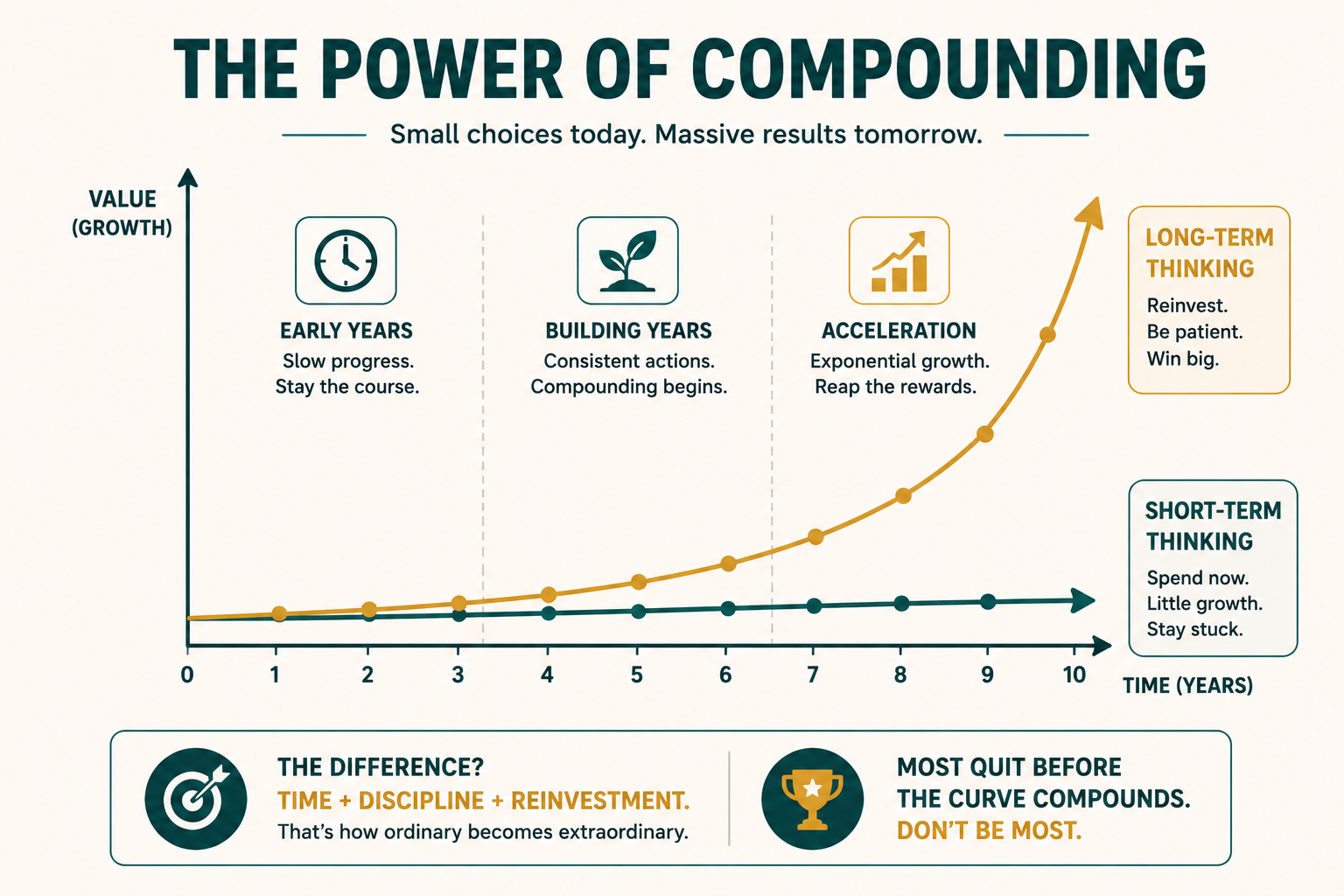
Compounding is a small, consistent advantage that grows on top of itself over time, producing a gap that looks tiny in year one and enormous by year ten. Delayed gratification is choosing that slow, compounding advantage over an immediately available, larger-feeling reward. Nearly every durable system in this manual is a delayed-gratification bet.
Why is the most valuable work so often the work that feels least urgent? Because its payoff is invisible for years, an emergency fund, a documented system, a trained successor all cost real time today and return nothing this week. The reward only arrives much later, all at once, which is exactly why short-term thinking skips them and why the businesses that don't skip them end up worth far more.
Writing down a system, building an emergency fund, or training a successor all cost real time today for a payoff invisible for years, which is exactly why they're so often skipped. The businesses that actually command Volume 25's strong sale price are usually the ones that made this trade consistently, for years, before anyone was watching.
The Compounding Curve
| Short-Term Choice | Long-Term, Compounding Choice |
|---|---|
| Spend a good month's cash | Build Volume 07's emergency fund |
| Skip documenting a process to save an afternoon | Build Volume 02's systems that keep paying off for years |
| Keep all knowledge in your own head | Build Volume 23's Knowledge Base |
The gap between the two paths looks small in year one and enormous by year ten. Nearly every system this manual describes is cheap now and valuable later. That is exactly why short-term thinking so reliably skips them.
Why This Requires a Deliberate Mindset Shift
Delayed gratification isn't a personality trait some owners simply have and others lack. It's a deliberate habit of asking "what does this choice look like in five years, not five weeks?" before a decision, especially when the short-term option feels obviously more appealing.
Example Story: The Documentation That Paid Off Years Later
Here's the full version of the years-of-documentation story from the start of this chapter.
Years of quietly documenting systems, training a successor, and keeping clean records at MANIAC MINDZ never felt urgent or immediately rewarding. Each individual afternoon spent writing a process down felt like time that could have gone to a more pressing task instead.
When the business was eventually prepared for sale, exactly as Volume 25, Chapter 2 describes, those years of unglamorous, compounding discipline were the entire reason it sold quickly, at a strong price. The payoff had been invisible for years, right up until the moment it mattered most.
Across Industries
The specific compounding choice differs by trade, but each one shares the same shape: a small cost now for a large, delayed payoff.
| Business | A Compounding Choice Worth Making Now |
|---|---|
| Golden Crust Bakery | Documenting recipes now, for a payoff at the next hire or eventual sale |
| Rapid Auto Works | Building an emergency fund during a good season, not spending it all |
| Precision Print & Press | Training a second colour-matching expert years before it's urgently needed |
Common Mistakes
Most of this manual's systems cost now and pay off later. Judging them by day-one return undervalues them completely.
The compounding gap applies at any size. A small business's documented systems compound just as reliably as a large one's.
The curve is genuinely flat-looking early on. Quitting during that stretch is exactly when most of the value is lost.
Quiz Yourself
Practice Exercise
Pick one system from this manual you've been putting off because it "doesn't feel urgent." Start it this week, and write down what you expect it to be worth in five years.
Quick Summary
Quick Summary
- Compounding advantages look small at first and become dramatic only after years of consistency.
- Nearly every system in this manual is a delayed-gratification bet: cheap now, valuable later.
- Next, Chapter 5: Why Customers Complain looks at the psychology behind what a complaint is really asking for.