Volume 31, Chapter 1
When to Hire
Definition
Exhausted after months of 12-hour days, MANIAC MINDZ brought on a new hire expecting immediate relief. Within weeks, the new hire was just as overwhelmed as everyone else, and the business was no better off. The real problem had never been a shortage of hands. It was an undocumented, inefficient cutting workflow that the new person simply inherited.
is one of the most important and most poorly timed decisions a small business makes. Most owners hire because they're exhausted, one of the worst reasons. This chapter gives four real stages, only the last two of which are genuinely a reason to hire.
Why doesn't hiring fix exhaustion when the exhaustion is real? Because tiredness can come from two completely different sources, too much work for the number of people, or a broken system making the work harder than it needs to be, and only the first is actually solved by adding a person. Hire against the second, and you just pay someone to be stuck in the same broken process.
Being busy doesn't mean you need to hire; it might mean your systems are broken. The real test is whether the business is actually losing opportunities for lack of people, and whether a new hire would generate more value than they cost. Hire against evidence, not exhaustion.
The Four Stages
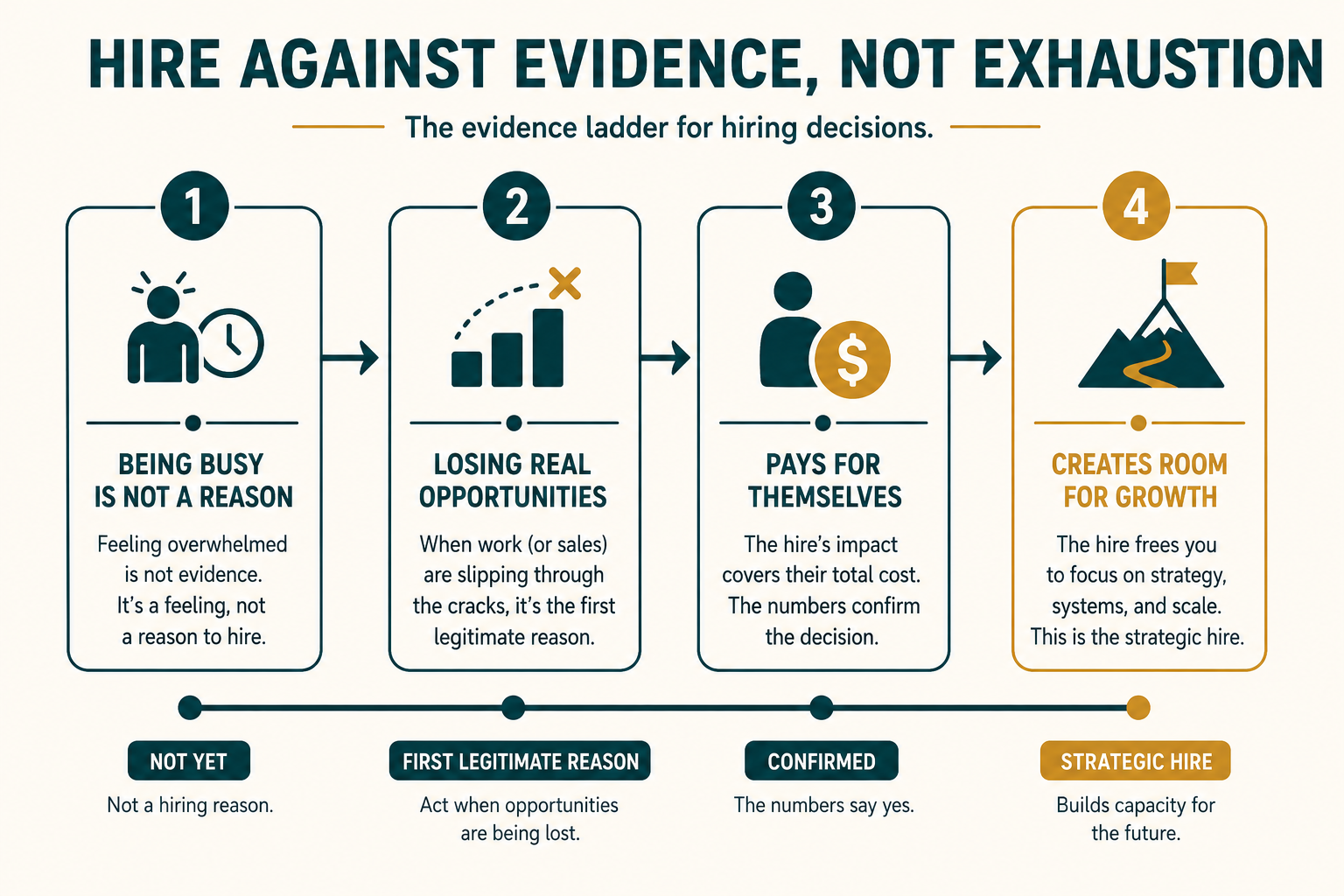
| Stage | What's Happening | Should You Hire? |
|---|---|---|
| 1. You're busy | Full 12-hour days, constant motion | Not necessarily. This may be Chapter 9's busyness trap or an undocumented system, not a staffing shortage |
| 2. The business is losing opportunities | Missed calls, late deliveries, turned-away customers, marketing abandoned because you're always producing | Yes, this is usually the first genuine reason |
| 3. One new employee pays for themselves | A hire at ₦120,000/month should generate at least ₦120,000 more in value, ideally 2–5x their cost | Confirms the hire is financially sound |
| 4. Hiring creates capacity for growth | The hire doesn't just reduce your workload. It lets the business serve more customers, improve quality, or free you for higher-value work | The strategic hire |
Tiredness alone never justifies a hire. Lost opportunities and a clear value return do. Fix the system before you fund a person to compensate for it.
Fix the System Before You Hire to Relieve Exhaustion
Before treating Stage 1 as a reason to hire, apply Volume 02's systems test: is the exhaustion coming from a genuine capacity shortage, or from an undocumented, inefficient process that a new hire would simply inherit and struggle with too? Hiring to compensate for a broken system multiplies the cost of the problem instead of fixing it.
The 2–5x Rule
Recall Volume 29, Chapter 8's opportunity cost: a hire's cost is easy to see on the payroll; the value they generate has to be actively estimated. A useful minimum: a new hire should generate at least as much additional value as they cost, and ideally 2–5 times that, depending on the role. Below that, the hire is an overall loss, however much it reduces personal exhaustion.
Example Story: The Hire That Solved Nothing
Here's the full version of the hire-that-solved-nothing story from the start of this chapter.
Exhausted after months of 12-hour days, MANIAC MINDZ brought on a new hire expecting immediate relief, but the underlying problem had been an undocumented, inefficient cutting workflow, not a genuine shortage of hands. The new hire inherited the same broken process and became just as overwhelmed within weeks, while the actual bottleneck remained completely unaddressed.
Adding a person to a broken system had simply produced two exhausted people instead of one. Only after documenting the workflow properly, per Volume 02, did the next hire actually create the relief the first one was expected to provide, made for Stage 2's real reason: lost opportunities.
Across Industries
The specific trigger that signals a genuine staffing shortage looks different in every trade, but it's always a lost opportunity, not just a tired owner.
| Business | A Hiring Trigger Worth Testing |
|---|---|
| Golden Crust Bakery | Turning away wholesale orders because production can't keep up |
| Rapid Auto Works | Missed calls during peak hours, losing bookings to competitors |
| Precision Print & Press | Marketing and client outreach abandoned because everyone is on the press |
Common Mistakes
The exact failure in the example story. A new hire inherits a broken system instead of fixing the actual bottleneck.
Skips Stage 3 entirely, risking a hire that costs more than it brings in.
A Stage 2 hire (stopping losses) and a Stage 4 hire (creating growth capacity) justify themselves very differently. Treating them as the same thing weakens the case for both.
Quiz Yourself
Practice Exercise
Before your next hire, identify which of the four stages actually applies. If it's Stage 1 alone, document the underlying system first and re-check whether the need for a hire still holds.
Quick Summary
Quick Summary
- Being busy alone doesn't justify a hire. Check whether a broken system is the real cause first.
- The first genuine reason to hire is losing real opportunities: missed calls, late deliveries, turned-away business.
- A sound hire should generate at least as much value as it costs, ideally 2–5 times that.