Systems beating memory, physically
Everything Volume 02 said about documentation applies here, the pattern is the documentation.
Volume 05, Chapter 1
A pattern is a system you can hold in your hands. Capture a design once, correctly, so it never has to be reconstructed from memory.
A good pattern can save hundreds of hours over its working life, which is exactly why it eventually becomes one of the business's most valuable pieces of intellectual property.
Everything Volume 02 said about documentation applies here, the pattern is the documentation.
Properly captured, it survives the person who built it, ten years and counting.
A recipe, a print template, a code module, a lesson plan, same idea, different name.
A pattern with no naming, no version history, no storage plan is still fragile.
Imagine a tailor's best cutter leaves the business after ten years. A customer returns wanting the exact wedding design he made years earlier. If that design only ever existed in his hands and habits, it is gone with him. If it was captured properly, a new tailor who never met him can open the same master template and produce the same garment. The difference between those two outcomes is a pattern.
A pattern (called a mould in some trades) is the master template a product is built from, the reusable master copy that lets the same design be reproduced accurately, again and again, without re-inventing it from scratch each time.
A pattern is the recipe card behind every repeatable product. Whether it's a cutting pattern for a jacket, a mould for a plastic part, or a standard template for a printed form, its whole purpose is the same: capture a design once, correctly, so it never has to be reconstructed from memory. A good pattern can save hundreds of hours over its working life, which is exactly why it eventually becomes one of the business's most valuable pieces of intellectual property, the valuable ideas and designs a business owns and can protect (Chapter 7).
Imagine cooking a complicated dish from memory every single time, with no recipe written down. Some attempts turn out well; others don't; none are quite identical, and training a new cook means standing over their shoulder for weeks.
Now imagine a written recipe card: exact ingredients, exact quantities, exact steps. Anyone competent can follow it and produce the same dish, consistently, and the business's quality no longer depends on one person's memory.
A pattern is that recipe card, for a physical product. Instead of ingredients and steps, it captures exact shapes, measurements, and construction instructions, precisely Volume 02's whole argument about systems beating memory, applied to production itself.
A pattern is a system you can hold in your hands. Everything Volume 02 said about turning memory into documentation applies here, the pattern is the documentation.
When does a new pattern get made at all?
Chapter 2How do we find it again, instantly, among hundreds?
Chapter 4What happens when the design changes?
Chapter 5How does it scale across sizes and individual bodies?
Chapter 3What happens when a pattern is no longer used?
Chapter 6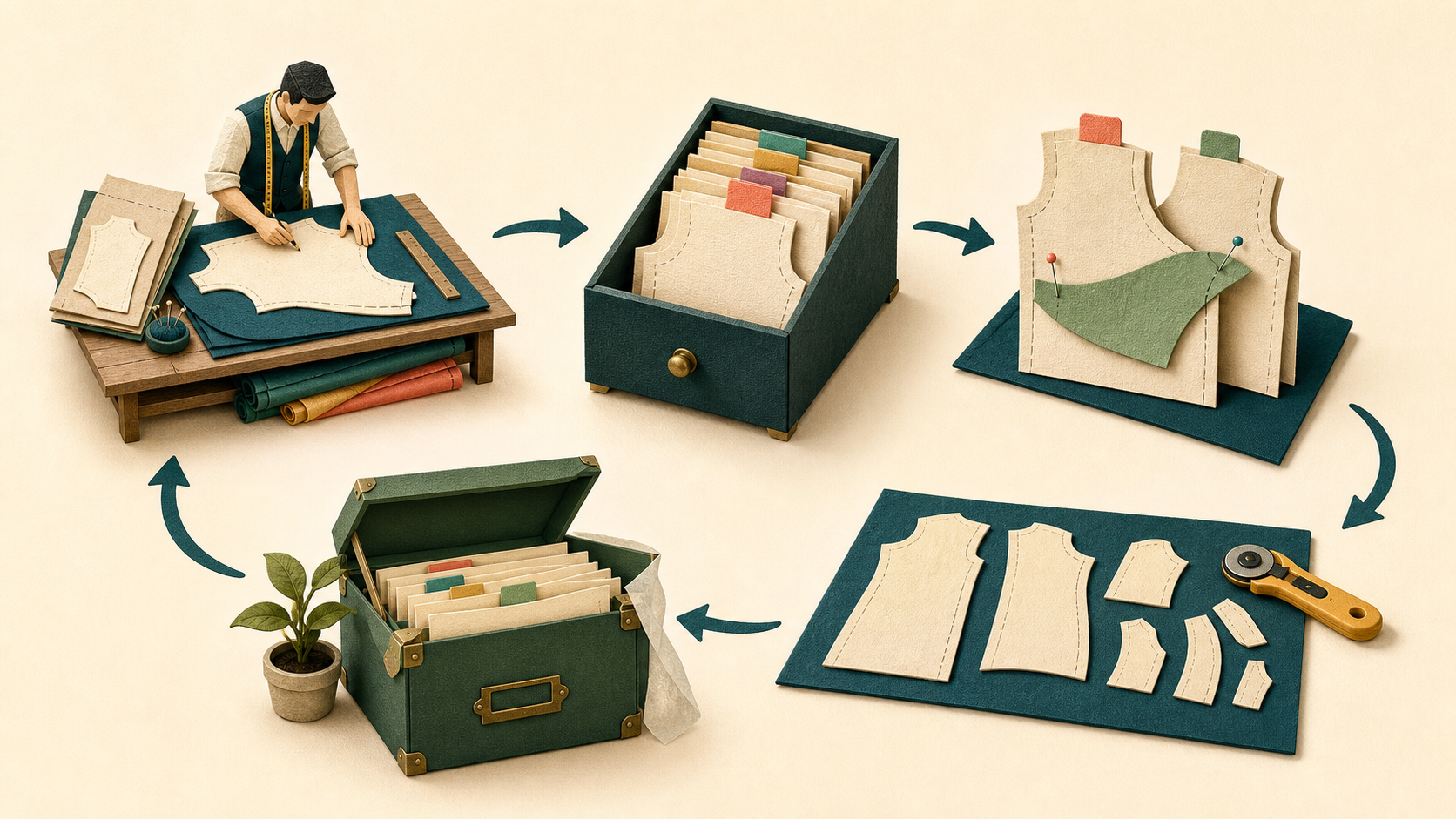
Every pattern in a well-run business moves through the same five stages, and this volume dedicates a chapter to each:
| Stage | Question It Answers | Chapter |
|---|---|---|
| 1. Created | When does a new pattern get made at all? | Chapter 2 |
| 2. Named & Catalogued | How do we find it again, instantly, among hundreds? | Chapter 4 |
| 3. Versioned | What happens when the design changes? | Chapter 5 |
| 4. In Use | How does it scale across sizes and individual bodies? | Chapter 3 |
| 5. Retired & Archived | What happens when a pattern is no longer used? | Chapter 6 |
A pattern that only exists in stage 1, created once, never named properly, never versioned, never archived, is barely better than no pattern at all: it will be lost, duplicated by accident, or quietly become outdated without anyone noticing.
| A One-Off Sketch or Cut | A Real Pattern | |
|---|---|---|
| Reusability | Made for one order, then discarded | Made to be used again, deliberately |
| Precision | Adjusted by eye in the moment | Exact measurements captured and fixed |
| Documentation | Exists only as the finished garment | Exists as a separate, storable master template |
| Value over time | Zero, nothing to reuse | Compounds, every reuse saves the time of remaking it from scratch |
This is the test for Chapter 2's question: if a design is genuinely one-off, a sketch is enough. The moment it might be reused, it deserves to become a proper, catalogued pattern.
MANIAC MINDZ's original Head Cutter developed a wedding agbada pattern still in daily use ten years after he left the business. Because it was properly captured, measurements, construction notes, fabric requirements, all recorded rather than left in his hands and habits, the business never lost the design when he did. New tailors learn from the same master pattern he created, producing the same quality he did, despite never having met him.
That pattern is not just a piece of paper, it's ten years of accumulated value the business would have otherwise had to reinvent, or simply lost forever. It is, quite literally, Volume 02's whole thesis made physical: a system that survived the person who built it.
| Business | Their Equivalent of a Pattern |
|---|---|
| MANIAC MINDZ | A cutting pattern for a specific garment |
| Golden Crust Bakery | A written recipe with exact quantities and method |
| Precision Print & Press | A print template/plate layout for a repeated job |
| Nimbus Labs | A reusable code module or software template |
| Bright Path Academy | A standard lesson plan or curriculum template |
The word changes from industry to industry, but the underlying idea does not: capture a reusable design once, precisely, so it never depends on memory.
Remaking the same design from scratch every time a customer reorders wastes exactly the hours a pattern exists to save. See Chapter 2's rule of thumb.
If the pattern isn't captured as a real, storable, catalogued object, the business hasn't actually protected itself against the maker leaving, see the example story above.
A pattern with no naming convention, no version history, and no storage plan is still fragile, the rest of this volume exists to close those gaps.