Protects the owner's assets
Helps protect the owner's personal assets, when the chosen business structure allows it.
Volume 09, Chapter 1
Before registration, you're just a person doing business. After registration, the law recognizes your business as an official business.
That means you miss out on many things a registered business can do, like opening a business bank account, signing contracts in the business's own name, and protecting your personal assets through the right structure.
Helps protect the owner's personal assets, when the chosen business structure allows it.
Many larger companies only buy from registered businesses.
Some businesses need extra licences as well.
Choosing the right one shapes the entire registration process.
Imagine MANIAC MINDZ receives the biggest order in its history. A company wants 2,000 uniforms for all its staff. The owner is excited. The fabric is available. The workers are ready. Then the company asks: "Can you send us your business registration certificate and tax identification number?" The workshop has neither. Overnight, the biggest opportunity in the company's history is at risk.
is the process of making a business legally exist in the eyes of the government. Once registered, the business can operate under its own legal identity instead of only under the owner's personal name.
Why does any of this matter to a government at all? Imagine anyone could claim to own a business without registering it anywhere. Nobody would know who really owned it. Customers wouldn't know who to complain to if something went wrong. Banks wouldn't know who to lend money to. The government wouldn't know who should be paying tax on the profit. Registration exists to solve exactly that problem: it gives every business one official identity, so everyone dealing with it knows exactly who they're dealing with.
Without registration, your business may not be able to:
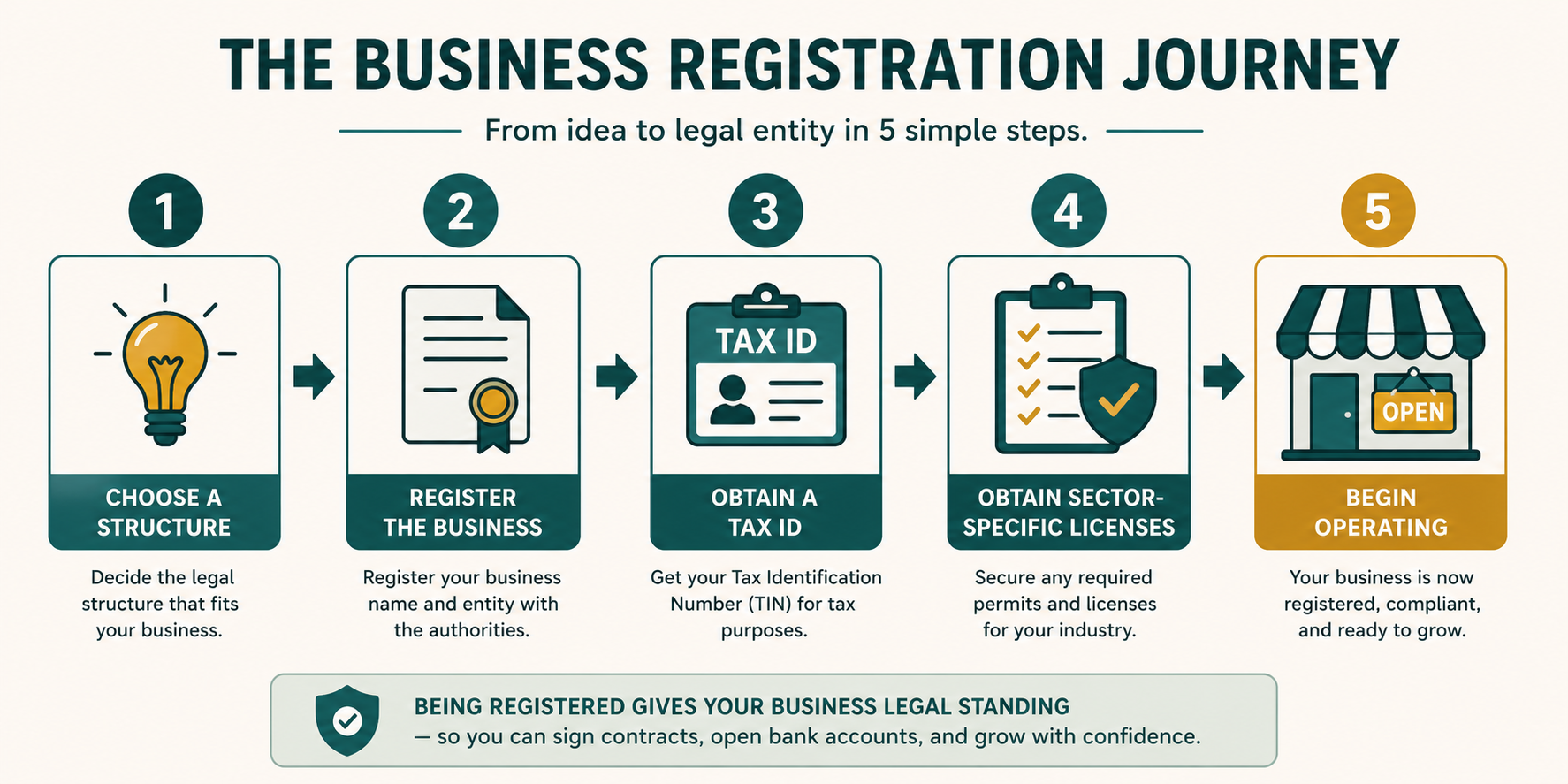
Sole proprietorship, partnership, or limited liability company.
Vol 03File with the relevant national registrar.
Registers the business with tax authorities.
Ch 2Some industries (food, health, finance) require additional approval.
| Step | What Happens | Cross-Reference |
|---|---|---|
| 1. Choose a structure | Sole proprietorship, partnership, or limited liability company | Volume 03, Chapter 2 |
| 2. Register the business name/company | File with the relevant national registrar | Confirm process with a local professional |
| 3. Obtain a tax identification number | Registers the business with tax authorities | Chapter 2: Tax Obligations |
| 4. Obtain sector-specific licenses/permits | Some industries (food, health, finance) require additional approval | Varies significantly by industry and location |
Every country has different forms, fees, and government offices for this (in Nigeria, it runs through the Corporate Affairs Commission, CAC). This chapter teaches the general process. Always check the specific rules for your own country before registering.
Helps protect the owner's personal assets, when the chosen structure allows it (Volume 03).
Most banks require registration before opening a dedicated business account (Volume 07, Chapter 8).
Taking on shareholders formally requires a registered company (Volume 03).
Many larger companies only buy from registered businesses.
A registered business can sue, and be sued, in its own name, rather than the owner personally.
Here's the full version of the 2,000-uniform story from the start of this chapter.
The company's purchasing department was clear: no registration certificate, no tax identification number, no contract, no exceptions. It didn't matter that MANIAC MINDZ had a seven-year reputation for on-time delivery, or that the fabric was already in stock, or that the workers were ready to start that week. An unregistered sole trader simply didn't qualify to sign.
One month later, the business was registered. The contract was signed. Nothing about the sewing had changed. The only difference was that the business now officially existed.
Registration is only the first step. Some industries also need extra permission before they can legally operate.
| Business | A Registration-Specific Requirement |
|---|---|
| City Kitchen | A food handling permit alongside standard business registration |
| Rapid Auto Works | A trade-specific operating license for vehicle repair |
| Nimbus Labs | Standard company registration, plus possible data protection registration (Chapter 6) |
Delays the legal protections and opportunities registration unlocks, see the example story.
Choosing sole proprietorship out of habit when a limited company would better protect a growing business, revisit Volume 03, Chapter 2 before registering.
Sector-specific licenses are often separate from general business registration, confirm what applies to your specific industry.
Confirm your business's current registration status. If unregistered, identify the specific registrar and process for your country, and the structure (Volume 03, Chapter 2) that fits your actual needs.