Equity is not refundable
If the business becomes worthless, shares become worthless too, down to ₦0.
Volume 03, Chapter 6
Equity investors share both the profits and the losses. Never invest in equity more than you can afford to lose completely.
An equity investor is not automatically refunded when a business fails, they can lose everything, because they bought part of the business, not a promise of repayment.
If the business becomes worthless, shares become worthless too, down to ₦0.
Normally you lose only what you invested, not your house, car, or savings.
Personal guarantees, fraud, and unpaid share commitments can break the protection.
A lender's best case is capped interest; equity's best case grows with the business.
Imagine Mr B calls Mr A five years from now and says, "MANIAC MINDZ is closing. I want my ₦5,000,000 back." Is Mr A required to pay him? The answer depends entirely on one thing: whether Mr B bought shares or lent money. If he bought shares, the honest answer can be "there is nothing to give you." That single fact surprises most first-time investors.
is the process of closing a business permanently: selling everything it owns, paying the people it owes in a strict order, and giving whatever is left (if anything) to the owners.
Can an investor get their money back when the business fails? It depends entirely on what type of investment they made. An equity investor is not automatically refunded, they can lose everything, because they bought part of the business, not a promise of repayment. A lender stands ahead of shareholders in the payout queue, but even a lender only recovers what the leftover assets can cover.
Full glossary entries: Liquidation · Creditor · Limited Liability
This is one of the most important questions in investing, and almost nobody asks it before handing over money:
"If this business fails, what happens to my money? Can I get it back?"
Many people quietly assume investing means "I'll always get my money back eventually."
That is not true.
The honest answer depends on what type of investment you made:
No automatic refund. Paid last, only from whatever remains, often nothing.
Highest riskAhead of shareholders, behind secured lenders. May recover all, part, or none.
MiddleA legal claim over specific assets. Usually paid first from their sale.
Lowest risk| If you invested as... | If the business fails, you... |
|---|---|
| Equity (shares) | Get no automatic refund. You are paid last, only from whatever remains after every debt is settled, which is often nothing. |
| Unsecured loan | Join the creditors' queue ahead of shareholders, but behind secured lenders. You may recover all, part, or none of your money. |
| Secured loan (with collateral) | Have a legal claim over specific assets (for example, the machines). You are usually paid first from the sale of those assets. |
The rest of this chapter walks through each case, using the same deal from Chapter 3: What Is Equity?: Mr B invested ₦5,000,000 in MANIAC MINDZ for 20% ownership. This time, we imagine the sad timeline.
Suppose:
For three years, the business operates. Then it starts losing customers. Sales fall. Bills pile up. Eventually the business closes.
He does not automatically get it back.
Why? Because he didn't lend the business money. He bought part of the business.
When he bought shares, he accepted both the rewards and the risks. If the business becomes worthless, his shares also become worthless. His investment can fall to ₦0.
Equity investors share both the profits and the losses.
Back to the pizza from Chapter 3: if the whole pizza burns in the oven, owning 20% of it means owning 20% of a burnt pizza. Nobody owes you a fresh slice.
Usually a failed business isn't completely empty. Imagine MANIAC MINDZ closes, but it still owns:
These assets (things the business owns, see Asset) can be sold. But the money from selling them does not go to the investors first. There is a queue.
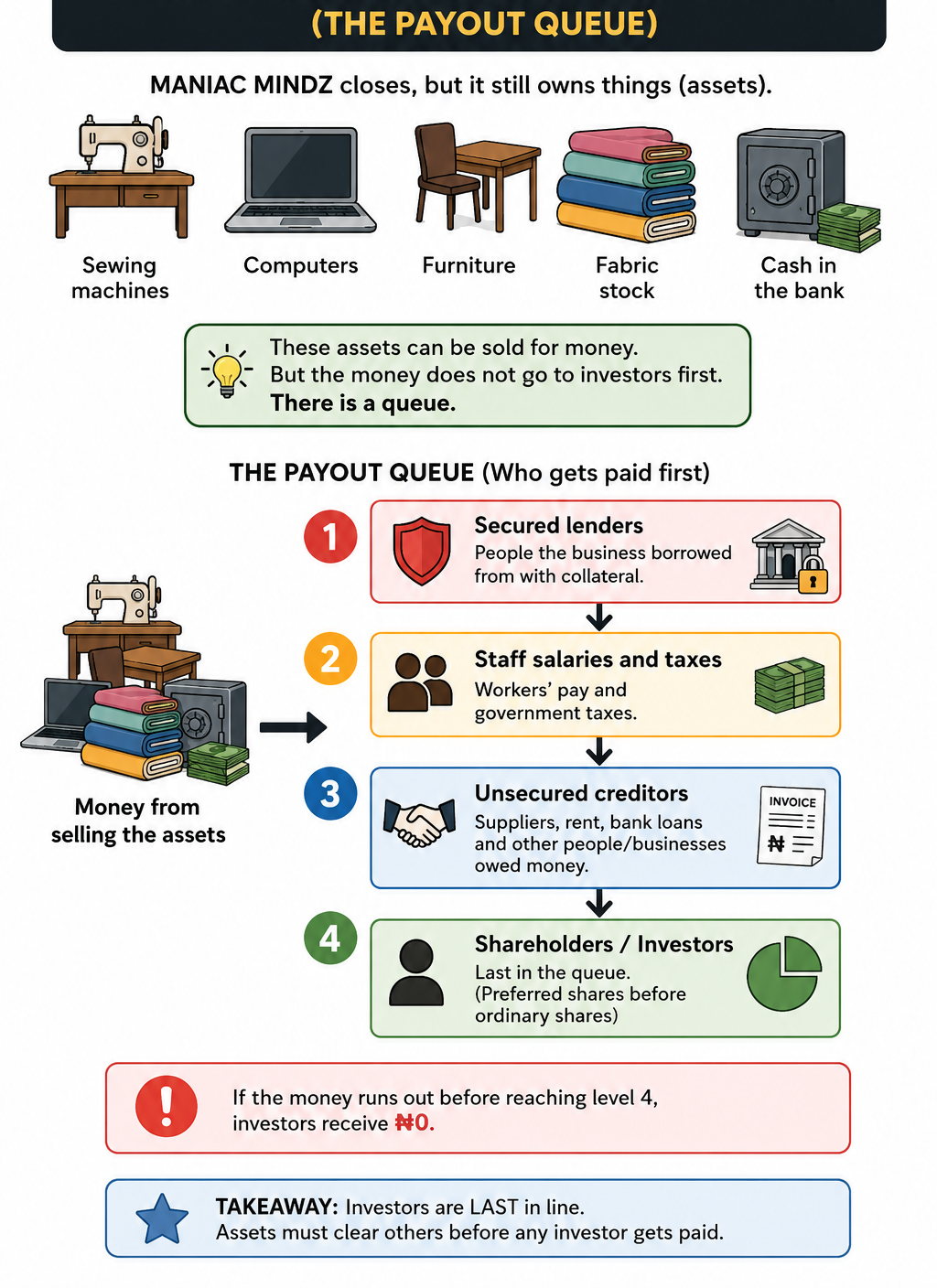
Everything the business owns is sold:
| Asset | Sale Price |
|---|---|
| Sewing machines | ₦6,000,000 |
| Furniture | ₦1,000,000 |
| Remaining fabric stock | ₦2,000,000 |
| Total raised | ₦9,000,000 |
Before owners receive a single naira, the business must pay what it owes, its debts (see Debt). For example:
| Debt | Amount |
|---|---|
| Staff salaries owed | ₦2,000,000 |
| Taxes owed | ₦1,000,000 |
| Suppliers (fabric, thread) | ₦2,500,000 |
| Bank loan | ₦2,000,000 |
| Rent owed | ₦500,000 |
| Total debts | ₦8,000,000 |
₦9,000,000 raised − ₦8,000,000 in debts = ₦1,000,000 remaining.
The exact legal order of who gets paid first varies by country (in many places: liquidation costs and secured lenders, then employee wages and taxes, then unsecured creditors, then shareholders). Always confirm the order that applies in your country with a qualified professional. What never changes: shareholders are at the back of the queue.
Only after all debts are settled do the owners share the remainder, in proportion to their ownership:
| Owner | Ownership | Share of the ₦1,000,000 left |
|---|---|---|
| Mr A (Founder) | 80% | ₦800,000 |
| Mr B (Investor) | 20% | ₦200,000 |
Mr B invested ₦5,000,000 but recovered only ₦200,000. The remaining ₦4,800,000 is simply lost. Nobody owes it to him.
Sometimes the debts are greater than the assets. This situation is called insolvency (see Insolvency):
| Amount | |
|---|---|
| Assets sold for | ₦8,000,000 |
| Total debts | ₦15,000,000 |
| Shortfall | −₦7,000,000 |
The business cannot pay everyone. The ₦8,000,000 runs out somewhere in the middle of the creditors' queue. After all the assets are sold:
Here's the good news for investors.
If MANIAC MINDZ is a limited liability company, Mr B normally loses only the ₦5,000,000 he invested, and nothing more. Even though the business still owes ₦7,000,000 in Scenario 3, nobody can take Mr B's house, car, or savings to cover it, simply because he is a shareholder.
This protection is called limited liability: the company is treated as a separate legal "person," and its debts belong to it, not to its shareholders personally.
Limited liability is a firewall between the company's debts and your personal pocket. The fire can burn everything inside the company, but it stops at the wall.
| Exception | What It Means |
|---|---|
| Personal guarantee | You personally promised, in writing, to repay a company loan if the company can't. The bank can now pursue you. See Personal Guarantee. |
| Fraud or serious wrongdoing | Courts can set aside the protection if the company was used dishonestly. |
| Unpaid share commitments | If you promised to pay for shares and haven't fully paid, you still owe that amount. |
| No limited company at all | Sole proprietors and ordinary partners have no firewall, business debts are personal debts. See Chapter 2: Business Structures. |
Signing a personal guarantee "just as a formality" to get a bank loan approved. A personal guarantee deletes your limited liability for that loan. Treat it as seriously as borrowing against your own home, because that can be exactly what it becomes.
This is different. Suppose Mr B didn't buy shares, instead, he lent MANIAC MINDZ ₦5,000,000.
Now he is a creditor (someone the business owes money to), not an owner.
If the business closes, Mr B has a right to repayment before shareholders receive anything. Whether he recovers all, part, or none of his money depends on:
| Secured Loan | Unsecured Loan | |
|---|---|---|
| What it is | The loan is backed by collateral, a legal claim over specific assets (e.g., the sewing machines) | The loan is backed only by the business's promise to repay |
| If the business fails | The lender is paid first from the sale of those specific assets | The lender waits in the general creditors' queue |
| Typical recovery | Higher, up to the value of the collateral | Lower, depends on what's left after secured lenders |
| Glossary | Secured Loan · Collateral | Unsecured Loan |
Worked example: A secured lender with a claim over the machines gets paid from the machines' ₦6,000,000 sale before anyone else touches that money. An unsecured lender shares whatever remains with the other unsecured creditors, and in Scenario 3, that might be only a fraction of what they're owed.
Because the upside can be much, much bigger.
Imagine Mr B invests ₦5,000,000 for 20% of MANIAC MINDZ. Five years later, the business has grown into a national brand and is now worth ₦500,000,000.
| At Investment | Five Years Later | |
|---|---|---|
| Business value | ₦25,000,000 | ₦500,000,000 |
| Mr B's stake | 20% | 20% (unchanged) |
| Value of Mr B's stake | ₦5,000,000 | ₦100,000,000 |
Mr B made ₦95,000,000 in value, and he may also have received dividends along the way.
That's the trade-off:
| Lender | Equity Investor | |
|---|---|---|
| Best case | Principal back + agreed interest, capped | Unlimited, grows with the business |
| Worst case | Partial or no recovery, but ahead of shareholders in the queue | Total loss (₦0) |
| Risk level | Lower | Higher |
| Reward level | Fixed, known in advance | Unknown, potentially enormous |
Before investing in anything, ask yourself one question:
"If this business completely fails tomorrow, can I afford to lose every naira I invest?"
If the honest answer is no, then an equity investment may not match your risk tolerance, consider a smaller amount, a secured loan structure, or not investing at all. Understanding that risk before investing is one of the most important principles of business finance.
| Business | Main Assets at Closure | Likely Recovery for the Queue |
|---|---|---|
| MANIAC MINDZ (Tailoring) | Industrial sewing machines, fabric stock | Moderate, good machines resell well; fashion fabric loses value fast |
| City Kitchen (Restaurant) | Kitchen equipment, perishable stock | Low, used kitchen gear sells cheaply, food stock is nearly worthless |
| Rapid Auto Works (Mechanic) | Tools, lifts, diagnostic machines | Moderate to good, quality tools hold their value |
| Nimbus Labs (Software) | Laptops, and intangible assets: code, brand, customer list | Unpredictable, few physical assets, but the software itself might be bought by another company |
| Green Fields Farm (Agriculture) | Land, equipment | Often highest, land tends to hold or grow its value |
Two investors can make the same-sized investment in two failed businesses and recover completely different amounts, because recovery depends on the assets, the debts, and the queue, not on how much was originally invested.
"When I need my money back, the founder will just return it." No, equity is not a deposit. See Scenario 1.
Assuming investors are paid first because "they put in the money." Shareholders are paid last, behind staff, taxes, suppliers, and lenders. See the payout queue.
A personal guarantee quietly removes your limited liability for that debt. See Section 6.
When a business fails, some founders personally repay equity investors even though no law requires it, sometimes going into personal debt to do so. If you feel a moral obligation, take professional advice first; don't turn one failure into two.
The time to explain "you could lose all of this" is before the money arrives, in writing, in the agreement. See the Equity Decision Checklist.
Q: So can I ever get my money back as an equity investor? A: Yes, but not by refund. You convert shares back into money by (1) selling your shares to someone else, (2) the founder buying them back, (3) receiving dividends over time, or (4) receiving your share of what's left if the company closes with money to spare. None of these is guaranteed.
Q: Who exactly gets paid first when a business closes? A: Typically: liquidation costs and secured lenders → employee wages and taxes → unsecured creditors (suppliers, rent, unsecured loans) → shareholders last, with preferred shareholders ahead of ordinary shareholders. The exact order varies by country, confirm locally.
Q: Are preferred shareholders safer than ordinary shareholders? A: Slightly. Preferred shares (see Chapter 3, Section 6) usually stand ahead of ordinary shares in the payout queue, but still behind every creditor. In Scenario 3, both types receive ₦0.
Q: Does limited liability protect the founder too? A: Yes, if the business is a limited liability company and the founder hasn't signed personal guarantees or committed wrongdoing, the founder's personal assets are generally protected as well. Sole proprietors and ordinary partners have no such protection.
Q: If the company still owes money after everything is sold, do shareholders have to pay the difference? A: In a limited liability company, generally no. The unpaid creditors absorb the loss. That is exactly what "limited" liability means, your maximum loss is what you put in.
Take any business you know well (or use your own):
Apply the Golden Rule to yourself, from both sides: as an investor, is there an amount you could lose entirely without damaging your family's security? As a founder, have you honestly told your investor that their money could go to zero, or have you let them believe it's a loan by another name? The most painful investment disputes come from that unspoken misunderstanding.