Four paths, one foundation
All four depend on the same preparation: an honest valuation and clean, trustworthy records.
Volume 25, Chapter 1
The right exit isn't automatically "sell to a stranger for the highest number." It's whichever path actually fits the business, its people, and the owner's real goals.
A prepared successor may make a management buyout the natural choice; a business whose strengths fit well with yours might merge instead; a business that's run its course can close in an orderly liquidation rather than a forced, messy one.
All four depend on the same preparation: an honest valuation and clean, trustworthy records.
A tested successor can make a buyout a genuinely better fit than an outside sale.
The right choice takes time to prepare properly, before it's needed, not after.
Culture, staff continuity, and payment structure can outweigh a single lump sum.
The owner's exit is how the founder eventually leaves the business they built, distinct from an investor's exit (already covered in Volume 03). It can happen four main ways: sale, buyout, merger, or liquidation, each suited to a different situation.
Selling to a stranger isn't the only way out, and it isn't always the best one. A prepared successor may make a management buyout the natural choice; a business whose strengths fit well with another's might merge instead; a business that's run its course honestly can close in an orderly liquidation rather than a forced, messy one.
Selling to an outside buyer at a negotiated valuation.
Clean breakManagement or employees purchase the owner's share of the business.
Needs a successorCombining with another business into one company.
Strengths that fitAn orderly wind-down: assets sold, debts paid in the payout queue.
Run its course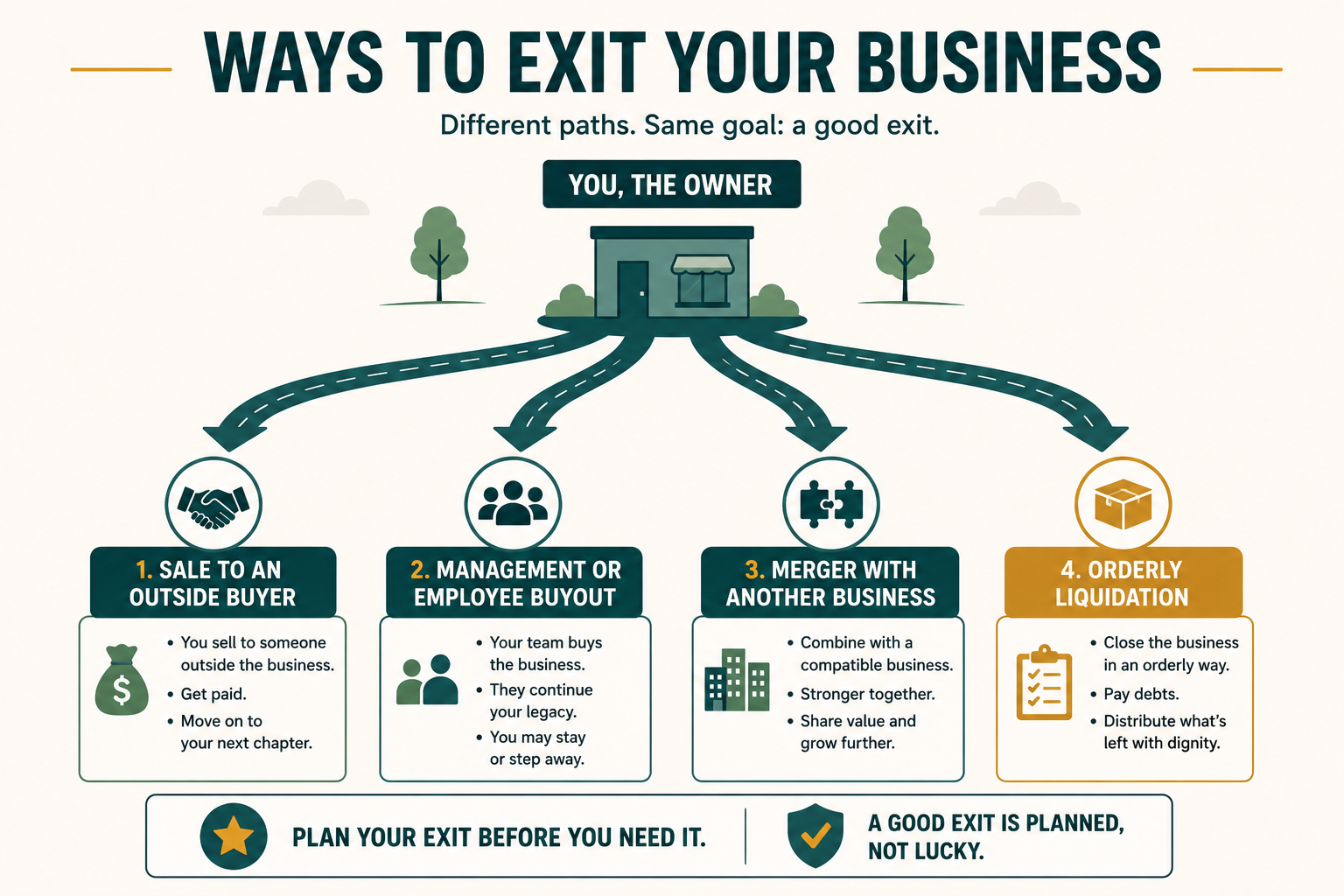
| Path | What It Is | Best Suited To |
|---|---|---|
| Sale | Selling to an outside buyer at a negotiated valuation | An owner wanting a clean break and maximum price |
| Buyout | Management or employees purchase the owner's share of the business | A prepared successor already exists |
| Merger | Combining with another business into one company | Strengths that fit together, shared growth ambitions |
| Liquidation | An orderly wind-down: assets sold, debts paid in the payout queue | The business has genuinely run its course |
The right exit isn't automatically "sell to a stranger for the highest number", it's whichever path actually fits the business, its people, and the owner's real goals.
An owner planning eventual retirement had always assumed the only realistic exit was selling to an outside buyer, until realizing that a long-prepared successor, already tested against every one of Volume 24's succession questions, made a structured management buyout a far better fit. It preserved the business's culture, kept every existing staff member in place, and gave the owner a payment structure spread over time rather than a single lump sum, an outcome an outside sale was unlikely to have matched.
The exit path that fits best depends entirely on each business's own relationships and staffing situation.
Overlooks a buyout, merger, or orderly liquidation that might genuinely fit better, see the example story.
Every path from Section 3 depends on knowing what the business is actually worth first.
Consider your own eventual exit. Which of the four paths currently fits best, given your successor situation (Volume 24), your goals, and the business's position? Write down why.