Survival before price
First ask what the bad month can carry. Cost only matters among the options that survive.
Volume 03, Chapter 8
A practical way to choose the funding structure whose cost, control, and worst case your business can actually live with.
Use this chapter to compare the seven funding options, remove the deals your cash flow cannot survive, and take a small shortlist into the investor conversation.
First ask what the bad month can carry. Cost only matters among the options that survive.
Voting equity, non-voting equity, loans, and hybrids each move control in different ways.
Daily sales, monthly sales, annual harvest income, and project revenue need different structures.
Loans end by repayment, RBF by cap, profit sharing by term, and equity only by sale or buy-back.
Imagine handing the same business plan to seven different advisers and asking, "how should I raise this money?" Each one answers with total confidence, and each one names a different structure: a loan, equity, a convertible, revenue-based financing. None of them is lying. Each is just picturing a different worst month for your business, one they never asked you about.
Chapters 3–7 introduced seven ways money can enter a business. This chapter puts them side by side, gives you a decision tree, and then does something more honest than declaring a winner: it shows how the right answer falls out of your priorities, using the three priorities most founders share.
There is no "best" funding option, there is only the option whose worst case you can survive and whose cost you can accept. Fixed-payment structures (loans) are cheapest when things go well and cruelest when they don't. Ownership structures (equity) are the reverse. The hybrids fall somewhere between those two extremes. Decide with three questions: Can my worst month pay a fixed amount? Am I willing to share ownership forever? Do I need the investor's silence?
Best for a risky leap where payments must flex. The cost is a permanent ownership slice.
Owns the growthBest when the worst month can carry the payment. The cost is interest, collateral, and default pressure.
Fixed paybackBest when valuation is unclear today. The cost is debt now and possible dilution later.
Valuation laterBest when sales vary but margins stay healthy. The cost is a share of revenue until the cap.
Breathes with salesBest when profit is provable. The cost is sharing defined profit for a defined term.
Needs clean booksBest when the investor wants returns, not a role. The danger is leaving the silence unwritten.
Behavior, not machineBest when equity needs a planned exit. The cost is funding the buy-back later.
Designed exit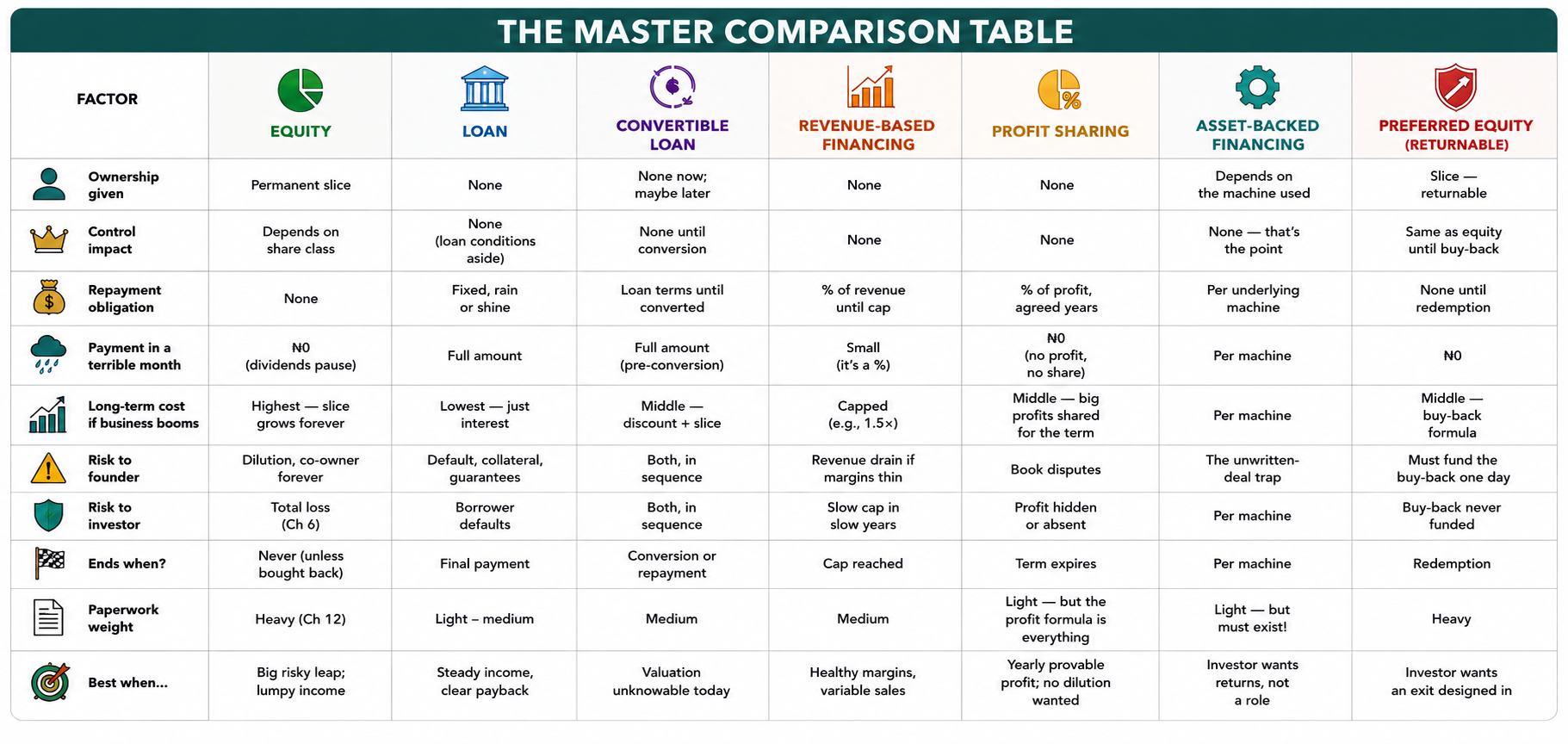
| Equity (Ch 3–4) | Loan (Ch 5) | Convertible (Ch 7) | Revenue-Based (Ch 7) | Profit Sharing (Ch 7) | Silent Partnership (Ch 7) | Redeemable Equity (Ch 14) | |
|---|---|---|---|---|---|---|---|
| Ownership given | Permanent slice | None | None now; maybe later | None | None | Depends on the machine used | Slice, returnable |
| Control impact | Depends on share class | None (loan conditions aside) | None until conversion | None | None | None, that's the point | Same as equity until buy-back |
| Repayment obligation | None | Fixed, no matter what | Loan terms until converted | % of revenue until cap | % of profit, agreed years | Per underlying machine | None until redemption |
| Payment in a terrible month | ₦0 (dividends pause) | Full amount | Full amount (pre-conversion) | Small (it's a %) | ₦0 (no profit, no share) | Per machine | ₦0 |
| Long-term cost if business booms | Highest, slice grows forever | Lowest, just interest | Middle, discount + slice | Capped (e.g., 1.5×) | Middle, big profits shared for the term | Per machine | Middle, buy-back formula |
| Risk to founder | Dilution, co-owner forever | Default, collateral, guarantees | Both, in sequence | Revenue drain if margins thin | Book disputes | The unwritten-deal trap | Must fund the buy-back one day |
| Risk to investor | Total loss (Ch 6) | Borrower defaults | Both, in sequence | Slow cap in slow years | Profit hidden or absent | Per machine | Buy-back never funded |
| Ends when? | Never (unless bought back) | Final payment | Conversion or repayment | Cap reached | Term expires | Per machine | Redemption |
| Paperwork weight | Heavy (Ch 12) | Light–medium | Medium | Medium | Light, but the profit formula is everything | Light, but must exist! | Heavy |
| Best when... | Big risky leap; uneven income | Steady income, clear payback | Valuation unknowable today | Healthy margins, variable sales | Yearly provable profit; no dilution wanted | Investor wants returns, not a role | Investor wants an exit designed in |
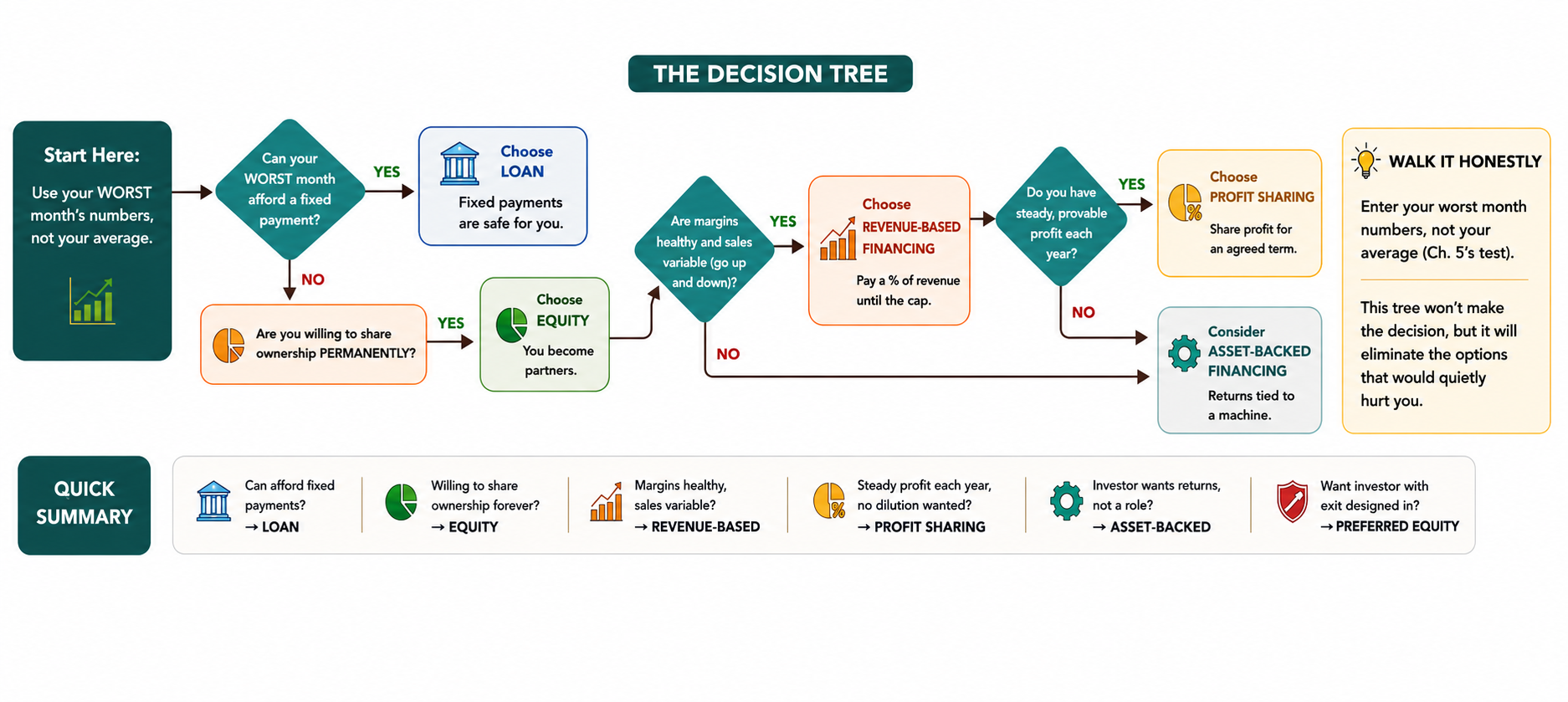
The tree won't make the decision, but it will eliminate the options that would quietly hurt you.
Walk it honestly, Chapter 5's testMost founders reading this share three priorities (they are the priorities this manual was written to serve):
Score each structure against those three:
| Structure | Control kept? | Daily silence? | Future governance risk | Verdict for these priorities |
|---|---|---|---|---|
| Ordinary voting equity | Noshared votes | Noinvestor can speak through votes | High, votes forever | Poor fit unless outside governance is desired |
| Non-voting equity + lock-in + buy-back | Yes | Yes | Low, rights written narrow | Strong fit (Mr A's actual choice) |
| Plain loan | Yes | Yes | None after payoff | Strong fit, if the worst month passes the test |
| Convertible | For now | For now | Deferred, becomes equity later | Medium, know what it converts into |
| RBF | Yes | Yes | None after cap | Strong fit, if margins are healthy |
| Profit sharing | Yes | Yes | Medium, annual profit disputes if books are weak | Good fit, only with clean books |
| Silent partnership | Depends | Yesif written | Medium if informal; low if structured | Strong only when the underlying legal machine is named |
| Redeemable equity | Yesif non-voting | Yes | Low, exit designed in | Strong fit, if you can fund the buy-back |
Notice what happened: the "winner" wasn't a structure, it was a shortlist shaped by the priorities. A founder who instead prioritized the cheapest possible funding or bringing in expertise would fill in the same table completely differently. That's the honest answer to "what is best": best at what, for whom, surviving which worst case?
Choose funding the way you chose the loan: not by the happiest projection, but by the worst month you can still survive. Every structure is a bet on which future shows up.
Same manual, same tree, three different exits, because three different worst months.
Cheapest-if-all-goes-well is how businesses die. First eliminate what the worst month can't survive; then compare cost among the survivors.
Whoever proposes the structure has optimized it for their side. Walk the tree yourself before the meeting, Chapter 9 prepares you for the conversation.
"It's a loan, but also he gets a bit of the profits, and maybe shares someday", three structures blended in speech and none on paper is a dispute with a countdown timer. Pick one (or deliberately combine two in writing).
Build your own Section 4 table: