Five drawers, one cabinet
Corporate, financial, operational, HR, and asset/customer/supplier records.
Volume 04, Chapter 1
"The books" means the complete set of business records, not one notebook. Lose a single record and the business can usually recover. Lose the whole set of records and nothing is left except memory.
Every record does one of three jobs: preserve history, provide evidence, or enable decisions. A business without them depends entirely on the owner's memory. That makes it hard to manage, impossible to audit, and risky to invest in.
Corporate, financial, operational, HR, and asset/customer/supplier records.
Dilution and buy-back math only work when the underlying books are trustworthy.
Reconstructing records under pressure, from memory, costs weeks an investor won't wait for.
Easier to finance, easier to sell, easier to survive a change in who runs it.
Imagine someone asks a business owner, "do you keep good books?" and the owner points to a single notebook of daily income and expenses. That notebook is real, but it is one page out of an entire filing cabinet. Ask that same owner to prove who owns the company, or show what it owns and owes, or produce the contract behind a supplier dispute, and the notebook has nothing to offer. "Books" was never supposed to mean one notebook.
are the complete set of official records that document who owns a business, how its money moves, what it owns and owes, what decisions have been made, and what obligations exist to employees, customers, suppliers, investors, and government authorities. "The books" is not one notebook, it's a whole filing cabinet.
One of the biggest mistakes small businesses make is believing "business books" means a notebook of income and expenses. In reality, business books are the entire memory of the business, written down, legal identity, money, day-to-day operations, people, and everything owned. A business without them depends entirely on the owner's memory: hard to manage, impossible to audit, risky to invest in (the manual's opening problem). A business with them can be handed to a manager, checked by an auditor, valued by an investor, or survived by a family.
Imagine the business as a filing cabinet with five drawers:
Legal identity, who owns it, what it's called, what it's registered as.
Drawer 1The money, everything earned, spent, owed, and owned in cash terms.
Drawer 2How work gets done: the written procedures and schedules.
Drawer 3The people, contracts, pay, performance.
Drawer 4Everyone the business deals with and owns.
Drawer 5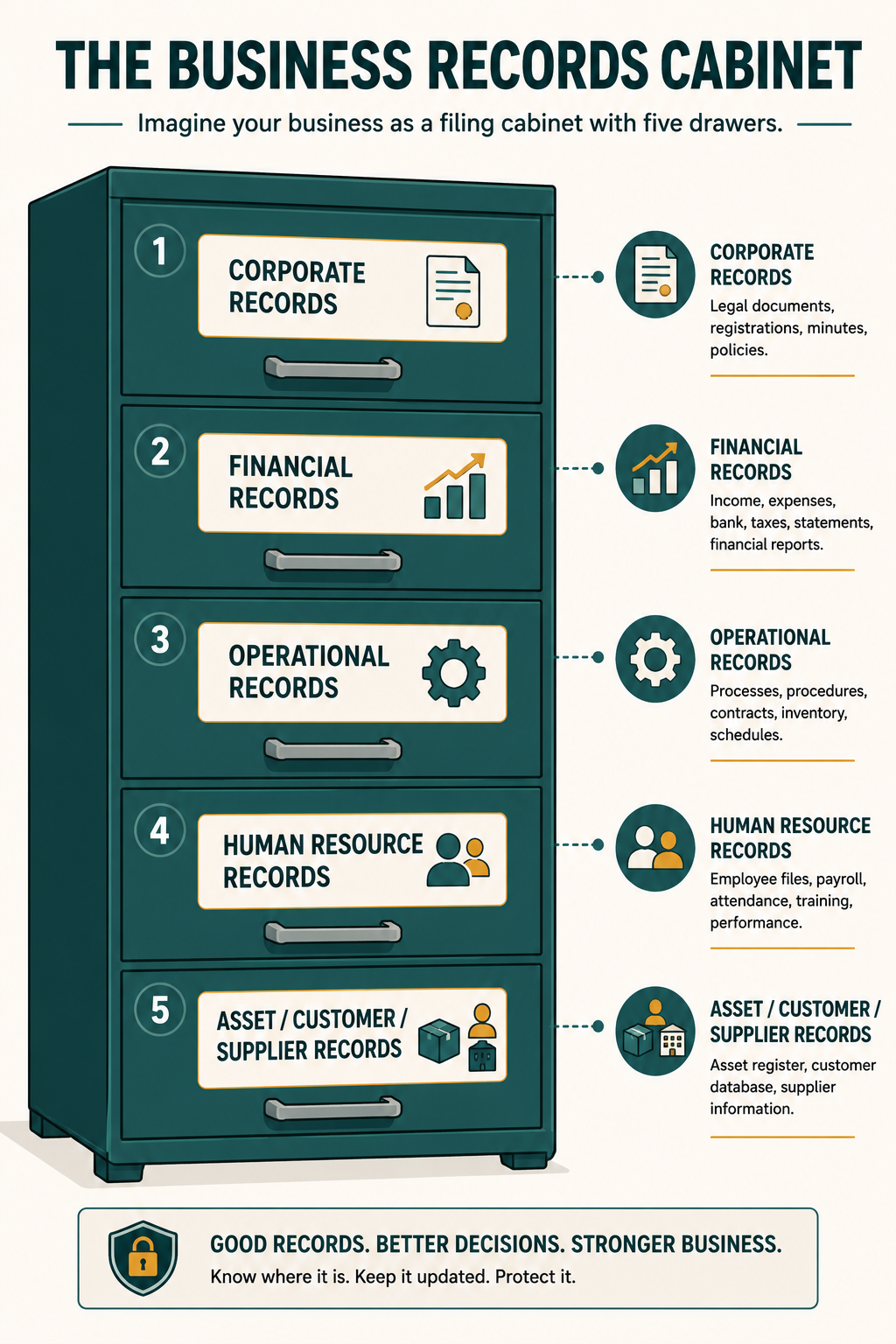
Open drawer one and you find the business's legal identity, who owns it, what it's called, what it's registered as. Drawer two holds the money, everything earned, spent, owed, and owned in cash terms. Drawer three holds how work gets done, the SOPs and schedules from Volume 02. Drawer four holds the people, contracts, pay, performance. Drawer five holds everyone the business deals with and owns, assets, customers, suppliers.
There are five drawers, and together they make up one cabinet. If the business loses one drawer, it can usually keep operating for a while. If it loses the whole cabinet, nothing is left but memory.
"The books" means all five drawers, not just one notebook. If you only picture a cash ledger when someone says "keep good books," remember there are four more record types this chapter covers.
Every record in every drawer does one of three jobs:
| Job | What It Means | Example |
|---|---|---|
| 1. Preserve history | What happened, and when | The cap table showing exactly when Mr B bought his 20% (Volume 03) |
| 2. Provide evidence | Proof when a question or dispute arises | A signed measurement card settling "you promised this fit" |
| 3. Enable decisions | Facts to decide from, instead of guessing | Knowing this month's real profit before promising a discount |
These three jobs are exactly why Volume 02's Six Questions always include "how is success measured?", a system with no record can't be measured, audited, or improved. Records are what let a system prove it's working.
| Without Records | With Records |
|---|---|
| Business depends entirely on the owner's memory | Business runs from written systems and files |
| Impossible to audit | Auditable, an outsider can verify what happened |
| Hard to finance | Banks and investors can evaluate real numbers (Volume 03, Ch 11) |
| Hard to sell | A buyer can see exactly what they're buying (Volume 25) |
| Disputes are one person's word against the other's | Disputes are settled by the signed document |
| Ownership changes are risky | The business survives a change in owner or manager (Volume 24) |
A business that keeps accurate books is easier to finance, easier to sell, easier to manage, and more likely to survive changes in ownership or leadership. This is precisely why Volume 03's dilution and buy-back math and Chapter 6's payout queue only work when the underlying books are trustworthy. Governance decisions and business records depend on each other.
For six years, MANIAC MINDZ's only "book" was a school exercise notebook: dates, amounts, a customer's first name. It worked, until Mr B's investment (Volume 03) required a real valuation.
The independent valuer asked for: incorporation documents (didn't exist, the business had never formally registered its structure), a shareholder register (didn't exist, ownership was "obviously" 100% Mr A's, nowhere written), 12 months of dated income and expense records (existed, but scattered across three notebooks with no totals), an asset list (existed only in Mr A's head), and any customer contracts (none, everything was verbal).
Getting investment-ready took six weeks of reconstruction before the first valuation conversation could even begin. Chapter 2 and Chapter 3 exist so that this kind of reconstruction never has to happen again.
| Business | What Fills the "Operational Records" Drawer |
|---|---|
| MANIAC MINDZ | Pattern registers (Volume 05), production schedules, machine maintenance logs |
| City Kitchen | Daily menus, food safety logs, supplier delivery records |
| Rapid Auto Works | Job intake forms, parts-used logs, warranty records |
| Nimbus Labs | Release logs, support tickets, server/uptime records |
| Green Fields Farm | Planting/harvest logs, irrigation records, yield-per-bed data |
Same drawer, same job (preserve history / provide evidence / enable decisions), completely different paper inside.
The single most common misunderstanding this chapter exists to correct. Cash is one drawer of five.
This is exactly the failure the Two-Week Test warns about. If it is not written down, it is not a record, it is only a memory, and memories fade or leave with the person who holds them.
Waiting for an investor, a bank, or a tax audit to demand records means building them under pressure, from memory, months or years late. Build the full set of records before anyone asks to see them.
Sketch your own five-drawer cabinet: